How to Write a Meet-Cute: Three Examples
Introduction
It seems, on the surface, trivial to acknowledge that any two people must have–at some point or another–met for the first time.
This is in the class of life events that are so obvious that they happen, consistently, without us taking any great notice of them. Screenwriting, however, has a habit of taking standard life events and injecting as much drama as possible into these.
It’s not to say that every time you introduce a character that someone hasn’t met yet (e.g. “hat-check girl #2” or “hat-check person #2” to be more up-to-date) you need to make a scene of it, so to speak. Nevertheless, there are classes of films where this becomes a real part of the film itself.
Classically, we might consider romances or romantic comedies to be films where two people meeting for the first time–or effectively for the first time, such as in When Harry Met Sally– becomes one of the film’s most memorable scenes. The sparks flying, often with unexpected tension or even hostility, is a great indication that this is a space to be watched. It’s a plant for paying off the romantic story throughout the rest of the film.
It would be reductive and, well, simply incorrect to suggest that this is a phenomenon specific to romance-based films, however. Almost any film with a romantic subplot has room for a spark-throwing meet-cute, and some of these films provide fabulous examples of said phenomenon despite (the film) not being in any primary sense a romance.
With that in mind, let’s look at three great examples of the meet-cute: one from a romance, one from a romantic comedy, and one from a film that is anything but–yet still lays living romance over its metal endoskeleton.
First, however, let’s talk about the term.
Why is it “meet-cute” rather than “cute meet”?
It’s a reasonable question, and you’ll see it written both ways in various books. The phenomenon is effectively as old as Hollywood itself. Early screenwriters knew that they wanted the audiences on the hook for the romantic potential as quickly as possible so they made a point to highlight the strangeness of characters’ very first interactions.
So in some sense, keeping people on the hook doesn’t mean that it’s “cute” in the “Cats of Instagram” sense, but rather that it’s tidy, clever, and has real stakes. In other words, it’s memorable in some tangible way. It’s a story to tell the grandkids. If the robot doesn’t kill them both first.
Many earlier sources, such as the inimitable Billy Wilder, tend to use the term “cute meet.” However, even in older sources, you’ll sometimes see phrases such as “it was important that they meet cute,” where the “meet” is a verb and the “cute” is a somewhat forced adverb.
(Then again, “meet cutely” makes me vom a little bit in the back of my throat so I’ll take the forced adverb in the end.)
What seems to have happened (the best we’ll ever get with folk etymology) is that eventually the verb+adverb form became a noun of its own. Writers being writers, those using the term regularly undoubtedly liked the fact that the word–as a curious portmanteau–sticks out of a sentence rather better than does “a cute meet,” which is just, well, an adjective and a noun.
So generally speaking these days you’ll hear about a meet-cute, but don’t worry–it’s exactly the same thing as a cute meet.
The Qualities of a Good Meet-Cute — (how to write a meet-cute!)
Naturally, two people have to meet. That’s sort of a given. What makes it a meet-cute, however, is the fact that the situation under which these people meet is actually rather strange, interesting, or humorous. In short, it drives the two characters into an artificially more intimate scenario from the jump.
The situation itself must create conflict: there will almost certainly be a clash of personalities or beliefs based on the situation itself, the two characters’ different reactions to the situation, or a fundamental problem that one is unlikely to grasp, let alone believe, e.g. “Trust me, lady, you’re being hunted by a cyborg assassin from the future.”
Now of course there are plenty of circumstances that aren’t meet-cutes: there’s nothing humorous or clever in 10 Things I Hate About You as Patrick first approaches Kat only to be summarily rejected. A better example, although tenuous as they technically met a few minutes earlier,might be Will spilling the juice over Anna in Notting Hill.
Remember, the awkward situation needs to drive these people into getting to know each other better, even if–and possibly better if–they’d really prefer never to know each other in the first place. Ideally, the awkward situation is the whole reason that they meet in the first place.
With that in mind, let’s look at a few excellent examples of the meet-cute.
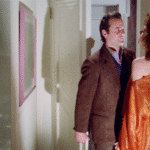
Before Sunrise (1994, w. Richard Linklater and Kim Krizan)
In first example, train passengers Jesse and Céline meet only because a German couple kick off a domestic that makes Céline uncomfortable enough to move. She finds herself She of course moves to the same row of seats as Jesse.
Let’s take a look at the beats of the scene. We could group the beats as more or fewer than eight, but eight tends to be a good number for a scene that arcs properly. In this case, there’s no turning back after point 3 (Break into Two) and point 5 should be the midpoint. Point 7 is often a lull rather than a real low point, while an outside force provides the energy to overcome the lull and lead to the climax, which shifts the energy further upward.
It’s useful to think about a screenplay as having a fractal structure: in this where the beats of the main script are reflected in the shape of each scene. In short, if we think about the film itself having eight beats, we can imagine each scene as well to have eight beats, which simplifies the process of breaking it down. As with any critical tool, don’t hold it too tight–the story here works, so don’t let the theory tail wag the story dog–and if the scene simply doesn’t fit the mold, it’s worth figuring out why.
Without further ado…
- In the train car, a woman enters a cabin. Back in cattle class, we see a German couple begin discussing what the man is reading in the paper,* and shots of Céline sitting next to them, other passengers, then Jesse in the back of the car.
- The argument heats up. The woman slaps the man’s hand and grabs the paper, disrupting Céline from her reading.
- Céline grabs her bag and moves to the back of the car as the man attempts to explain himself.
- Jesse watches her with interest as she puts her bag in the rack opposite him. After he’s returned to his book, Céline eyes him once, then twice. Jesse looks over again, seeing no good opportunity to engage with Céline.
- The woman gets up and stalks to the back of the car; the man follows. She tells him not to come with her. Jesse and Céline make eye contact, mutually acknowledging the ridiculousness of the circumstance. Jesse sees an entry point and asks whether Céline understands what the argument was about. She tells him she doesn’t know as she doesn’t speak German.
- Jesse takes this as a brush off and opens his book again. Céline tosses the ball back to Jesse: she asks whether he ever heard that couples become physically unable to hear one another as they get older.
- They compare each other’s books. The couple comes back, still arguing.
- Jesse invites Céline to the lounge car. She accepts.
The first thing to notice about this scene is that the awkward situation–the fighty German couple–is precisely the reason that Céline and Jesse meet in the first place. Without their interference, Céline would never have moved to the back of the car.
Note as well how the disruptive influence here is actually thematic: Céline and Jesse, idealistic young people, would never become an older couple who bicker in public (clearly that never happens in real life). The entire rest of the film is an ideal relationship–albeit a tragically finite one–diametrically opposed in terms of interest in the other, mutual respect, and surely many other things to the example of the German couple.
Second, consider the setup.
While 1995 was before the days when a random stranger striking up a conversation was inherently “creepy” or “problematic,” it was never, even in these prehistoric times, easy to engage conversation with a random stranger you’re attracted to–even if you vibe that the feeling is reciprocated. If nothing else, general etiquette tells us just to leave people alone unless there’s a good reason. Hence, some sort of pretext must be in order.
With this in mind, note how Linklater deftly uses the continuing disruption of the fighting couple to raise the stakes throughout the scene: they cause Céline to move in the first place, then leaving the car gives Jesse a reasonable pretext for a question–and possibly more.
Third, note how the fragile conversation is boosted by each appearance of the couple. The ostensible disruption that is annoying everyone else in the car is actually working a sort of magic on Céline and Jesse. They are drawn closer every time the couple does something stupid. Any initial conversation could stall out at any point; notice the small lull before the couple passes the final time. The couple passing provides a pretext for Jesse to escalate and ask Céline to the lounge car.
In three moves, the fighting couple has, unwittingly, caused Jesse and Céline to go from strangers to fast friends to embarking on (some sort of) a date in the lounge car.
In your own script, think about how you can keep leaning into the awkwardness of the premise to escalate the development of your characters’ newfound relationship.
*With my limited German, it appears to be that he is reading an article about women who drink too much. The wife retorts that he drinks too much, and he tells her he drinks because he’s married to her. And they’re off…
Say Anything (1989, w. Cameron Crowe)
This is an interesting one: on the surface it doesn’t look like a meet-cute, but for all intents and purposes it is.
It’s certainly an odd situation. Lloyd has called Diane’s house and left a message, but she actually has no idea who he is. That’s a strange setup. In today’s era of rampant ghosting–to mention but one of many mines in the field of sexual politicking–it’s possibly surprising that Diane would even return his call.
However, even 35 years ago, that might have been the case: Lloyd was willing to make the cold call and even leave the message, yet he seems surprised that she has responded. Lloyd is like a dog that chases a car and actually catches it.
The loveable thing about Lloyd is that he’s able to make it work. In short, he’s willing to make a fool out of himself and try.
Diane admits to the fact that she doesn’t know early in the conversation, but Lloyd’s enthusiasm and sales skill convince her to go on a date with him, sight unseen. Only at the very end does she get a glimpse of his face–from her yearbook. She’s not necessarily impressed.
Now sticklers might protest here and tell me that they’ve already met (indeed, they sat next to one another at Bell Square). However, the fact that Diane seriously doesn’t know who the hell Lloyd is makes it a reasonable case of “meeting” for meet-cute purposes.
Ultimately, this awkward-yet-charming back-and-forth cut phone conversation has captivated multiple generations.
Let’s look at the beats in more detail:
- Diane calls Lloyd. He is freaked out that she actually bothered to call back. (Kudos to the man for chutzpah).
- He compliments her straightaway on her speech and acceptance to Oxford. She is silent. The conversation stalls.
- He asks whether she even knows who he is. She tells him they sat together at Bell Square. He is relieved–but she admits she read it on the message (rather than actually remembering him). Lloyd is now on the back foot.
- Again with the chutzpah: he simply asks her out. She keeps telling him she’s busy. He asks whether she’s “monumentally busy.” She says “not monumentally” and he proposes a party that night. Diane pauses.
- Lloyd plows ahead, telling her he won’t allow her to miss the party that night–it’s hosted by a guy who’s 22 and dresses like a chicken; she’d never forgive herself!
- Diane is almost sold, ready to tell him she’s in–but Lloyd cuts her off, explaining enthusiastically how he lived in England as a child and can give her “An enormous amount of tips. Many tips. English tips.” Diane makes surprised-at-this-behavior faces.
- Diane agrees. He agrees to pick her up at 8pm. They say goodbye.
- Diane checks her yearbook to see who the hell Lloyd Dobler actually is. She sees the photo and drops the book, making a curious face–her reaction isn’t overtly negative, but it’s not wildly enthusiastic.
First, let’s not forget to overstate the obvious: this is a phone call. They aren’t actually meeting one another in person.
It’s a rather strange situation where someone can jump up a quanta in a relationship without a face-to-face interaction. Or at least it was in 1989. And that’s the point.
The important thing to note here is that Diane is at least partially game here; she called back. Now this could be due to the fact that she is a very honorable and decent person and would call back anyone who left a message.
But, really, who does that?
It’s more likely that the mystery of this unknown Lloyd person intrigued her and she wants to get a better idea who this person is and why he’d have the nerve to call her at home. That doesn’t mean she’s sold–far from it. But it’s not a closed door. Remember, that would simply be failing to return the call.
Second, note that Diane is polite, but largely dismissive. Lloyd’s hyperactive positivity keeps the whole conversation going. This even steps over Diane in the middle, when she seemed reasonably ready to agree to go with him.
There’s a big element here of “who is this guy? Is he nuts?” and finally one of “if he’s this keen, why not give him a shot?” This might be mixed in slightly with Lloyd’s logical point that Diane has missed all the high school parties up to this point, so she shouldn’t miss the final graduation party. Still, agreeing to go with Lloyd means investing in an evening in Lloydspace, not merely attending a random party as a singleton.
Pay attention to how Lloyd is overeager, but charming and cute, tripping over himself and picking himself back up. His hyperactive dialogue is like a Buster Keaton routine, full of high hopes and pratfalls. In most actors’ hands, this could be painful–yet Cusack has the perfect puppy-dog energy to pull it off.
(Aside: It really seems like a lot of this might have been improvised, but I’ve read the actual draft script from 1988 (that is, not some shit DVD transcription) and the dialogue is almost word-for-word. Interestingly, the final beat with the yearbook–one of the best parts of the scene–is NOT in the script.)
Third, again on the topic of Lloyd somewhat steamrolling Diane in the conversation. It’s true that he has about 90% of the dialogue in this scene. However, the interesting point to be made is that he doesn’t actually have the upper hand.
Remember, he’s the one who called to ask her out so she has every right to deny him that. They actually aren’t meeting as equals as one might expect for most meet-cutes. That is, it’s not a situation of “he wants the shirt and she wants the trousers” situation (or vice-versa) where the investment is similar.
Lloyd in some sense has put himself already in the position of the dancing monkey, so he does need to dance to please Diane. Luckily, she ultimately is pleased, if slightly overwhelmed. But pleasant-if-overwhelming is a reasonable way to describe Lloyd’s charm, and Lloyd’s charm is effectively the engine keeping the film running.
Notice how this small scene is actually a microcosm of how the rest of the film pans out. Essentially, Diane is timid and slightly rigid, but willing to blossom given the right attention. Lloyd seems scattered and overwhelming, but when he is able to focus his ADHD tendencies on Diane–scary as that sounds–it turns out to be the thing that helps them both learn, grow, focus, and thrive even in the face of Diane’s family disaster.
The Terminator, (1984, w. James Cameron and Gale Ann Hurd)
Here you go: I promised one that’s not in any way considered a romantic comedy.
Now presumably there would have to be a romantic element to perpetuate a meet-cute; even a situation like Fight Club’s “ass or crotch” airplane moment, or Ratso conning Joe Buck in Midnight Cowboy leads to some sort of relationship that easily accepts a romantic read between the two characters. Same for any sort of film that’s not technically a romance yet has a romantic subplot, such as The Terminator.
First, let’s break down the beats of the meet-cute scene: to set it up, Sarah is out at a nightclub and the T-800 has already murdered her roommate and the roommate’s boyfriend. Kyle Reese, the human resistance fighter sent back in time to protect Sarah, finds her at a nightclub moments before the machine does.
- Sarah calls her friend from the nightclub and leaves a message, conveniently tipping off the T-800 to her location.
- She then calls the police and they tell her to stay at the club.
- The T-800 enters; it barely misses seeing Sarah.
- Sarah notices Kyle across the room, standing at the bar.
- The T-800 clocks Sarah and approaches. Just as she looks up to see it, laser to her forehead, Kyle notices her and blasts it five times in the back with a shotgun.
- The T-800 gets up and fires alternately at Kyle, who is still firing at it, and Sarah who is trying to escape. It kills the woman immediately behind Sarah; the woman’s falling body trips Sarah.
- The T-800 comes over and takes aim at Sarah once more. Kyle blasts it several more times, sending it through a plate glass window and out into the street.
- Kyle grabs Sarah’s wrist: “Come with me if you want to live.” The two run out of the club with the T-800 loping after them. Kyle blows up the car next to his to slow down the T-800. Kyle and Sarah drive off.
First, obviously there is some sort of romantic subplot to The Terminator, because, well, John Connor has to happen somehow. Otherwise there’s no premise to the film.
This is useful to bear in mind: the meet-cute develops extra weight when the romance is fundamental to the structure of the film: in this case, no romance, no plot–even if the Sarah/Kyle romance is technically a subplot.
(We don’t even have to get into the weirdness of their relationship or the fact that Kyle tells Sarah he’s a virgin who has–it is strongly implied–been beating off to her tattered photograph for years.)
Second, the connection does not need to be something that either person necessarily wants. In other words, this first encounter does not need to be the thing that changes each person’s trajectory. This will be more true in situations where the romantic story is a subplot rather than part of the main plot.
In the Before Sunrise example, this was just a relatively smooth interaction between two attractive young singles. In the case of The Terminator, it’s a literal (not figurative) matter of life or death. Sarah doesn’t necessarily want to be picked up by Kyle, cute as he might be. However she does, we may infer, “want to live.”
Understandably, decisions made under such tense circumstances will eventually backfire. It is only reasonable that Sarah cools off and begins to wonder whose hands she’s placed herself into. She starts fighting back, in fact, during the next scene, complicating Kyle’s getaway.
For situations where the two romantic partners might not necessarily like each other or want to be together, consider a situation that would realistically force them to depend on each other. A bellhop mixing up the partners’ suitcases won’t cut it.
Bonus points if this is an issue of actual life or death, but there had better be a substantial threat looming–be careful, however, and make sure the threat is something baked into the story. “Then a typhoon struck” just makes it sound like a Tommy Wiseau film; even Ed Wood had higher standards.
Third, building from the previous point: note that in this film, you’re seeing the collision of the A-story (the cyborg assassin trying to kill Sarah) and the B-story (Sarah and Kyle’s romance) for the first time. Much of what makes the meeting profound is not just its life-or-death nature, but that this is the actual Break into Two of the film: Sarah had a clue that something was up, but this is the real point where her life would never be the same–just look at her expression when she has the laser target on her forehead.
In a situation where the romance acts as the B-story, you’ll do well to have the characters meet and get involved in service of the A-story. This is done less well, for example, in Speed. Here it’s basically just random that Annie becomes the driver of the bus–it could easily have been any other person, and she is in no way linked to the bomb on board.
For your script, make sure that you engineer a way that the B-story romantic interests end up meeting for a specific reason that serves the A-story. Otherwise you’re back to Wiseau-isms.
Conclusion
Meet-cutes are perfect for romantic comedies given that they often pit characters who’d rather not know each other at all (or at least one of them would be in that position) against each other for some ridiculous-but-inherently-interesting reason.
Bonus points if you can make this reason something thematic: think giving Lloyd a back-against-the-wall reason to flex his puppy-dog charm.
Don’t forget, however, that you might be able to use the meet-cute for any situation where a film has a romantic subplot. The reason for meeting could be totally arbitrary, but it’s better if it links back to the main plot of the film.
While a meet-cute isn’t absolutely necessary for a romantic comedy (or any other type of film for that matter), it makes for a memorable scene. As usual, don’t shoehorn something that doesn’t fit, but it’s worth thinking about whether you can find a clever way to integrate a meet-cute into your plot.
Exercises:
Exercise 1: The Awkward Engine – from external disruption to forced intimacy
Goal: Build a meet-cute where an outside disruption causes the meeting and keeps escalating it–think “fighty German couple.”
- Consider two characters opposite in “vibe”: shy vs. outgoing, etc.
- Find an awkward public situation that lends itself to intervention/comment. Make this repeat throughout the scene (probably three times), each repetition escalating.
Make sure that the engine of (2) is what keeps things going between your two characters–remember, neither one is actively trying to meet someone. But somehow they end up connecting…
Exercise 2: The Pretext Trap – the “wrong channel” meet-cute
This is a situation where the level of the relationship increases dramatically given the situation. Think about Lloyd and Diane: why would a woman who’s effectively never met the guy accept a date from him?
- Choose a misaligned channel: phone call, WhatsApp voice messages, a neighborhood watch forum, someone cc’d incorrectly in an email thread, etc.
- One person reaches out–it doesn’t have to be romantic, but this isn’t totally off-limits. It’s likely to be bold (romantic) or accidental (not necessarily romantic). Regardless, the other person doesn’t have this in mind.
- However, this second person plays along–out of boredom, ego, annoyance, or anything other than genuine interest (that comes later).
- It may be helpful to have a status imbalance–it should not be two equals chatting shit. Rather, one person is on the back foot just because one person is supplicating somehow: this might be a class issue, a ridiculous situation (e.g. one of the people in the neighborhood chat is actually the one who vommed on the lamppost after taking too many shrooms), or, most generally, one person needs some sort of access from the other.
- Write the scene as an escalating negotiation, with the power shifting from the high-status person toward the low-status person.
Note that one of them will be bold and the other reserved, but play around with whether the high-status person is the bold one or vice-versa. Keep 90% of the dialogue with the bold one–but try writing the scene both ways and witness the difference in the escalation.
Exercise 3: A-Story Collision – make dependence forced!
This type of meet-cute is almost always structural rather than incidental. The reason that the two people are meeting has to do with the crisis of the A-story.
- Consider the bad situation: If X happens, then Y happens. It’s just that Y is a terrible outcome.
- Character A will be inside the problem–a target, the guilty party, etc. while Character B will be someone to pursue, protect, etc. who isn’t directly involved in the problem… yet.
- The wheels turning in the A-story are why the two run into each other in the first place: e.g. firestarter meets firefighter, etc.
- These two must cooperate immediately for mutual survival–bonus if one of them doesn’t want the connection but has no choice.
- Usually, this will work in three stages: 1) one clocks the other (e.g. Sarah seeing Kyle at the bar); 2) the shit hits the fan; 3) once the coast is relatively clear, questions arise – e.g., “who the fuck are you and why should I trust you?”; 4) they set off together.
Think about this all building up: how do you get people who have no reason to trust each other except for the immediate crisis to continue on together? Why should they trust one another? This is your challenge.
I’m going to write “how to write a meet-cute” here and bold it for SEO. Sorry.