How to Raise Stakes in a Film – Case Study: Sex Tape (2014)
“You need to raise the stakes.”
This is one of the most common pieces of advice one hears in the screenwriting world, and it’s not wrong. The problem is that it’s completely unclear how one would ever do such a thing.
That is, what does it really mean to raise stakes and where would you even find out how to raise stakes? (below, duh)
The common advice, of course, would be “make things a matter of life and death.” While I’d agree that this advice likely comes from the right place, the risk is that it’s often taken too literally. There’s only so many puppies you can kill or Mustangs you can chop to properly motivate a motherfucker.*
What the advice really refers to, even if it doesn’t sound as good, is metaphorical life and death. Perhaps a better way to look at stakes would be the risk of irreversible consequences.
Now, something irreversible isn’t necessarily bad. Parents of young children, for example, often claim that having children wasn’t a massive regret. (Wait until middle school…) What being irreversible really means is that it forces a life change. This means a quantum leap: one can easily level up, but there’s a severe risk of leveling down.
What really motivates people in this case is the fear of change. It’s true: change isn’t easy. Characters–and people in general–will fight tooth-and-nail not to experience any sort of change. It’s essentially Newton’s First Law–essentially, “an object motion stays in motion unless acted upon by an outside force”–except with the addition of “and will kick and scream like a little biznatch, however futilely, to make sure the force doesn’t change a damn thing.”
It’s this last part we’re concerned about. The whole of your film is about a character, well, being a little biznatch.
The film is an active demonstration of how such behavior works out for the character. We can hope that things don’t work out super well, at least not until late in the film, because that would of course mean that the stakes are too low.
With all that in mind, let’s look at an example.
*And here I’m using an example that actually works in context. Think of all the ones that don’t.
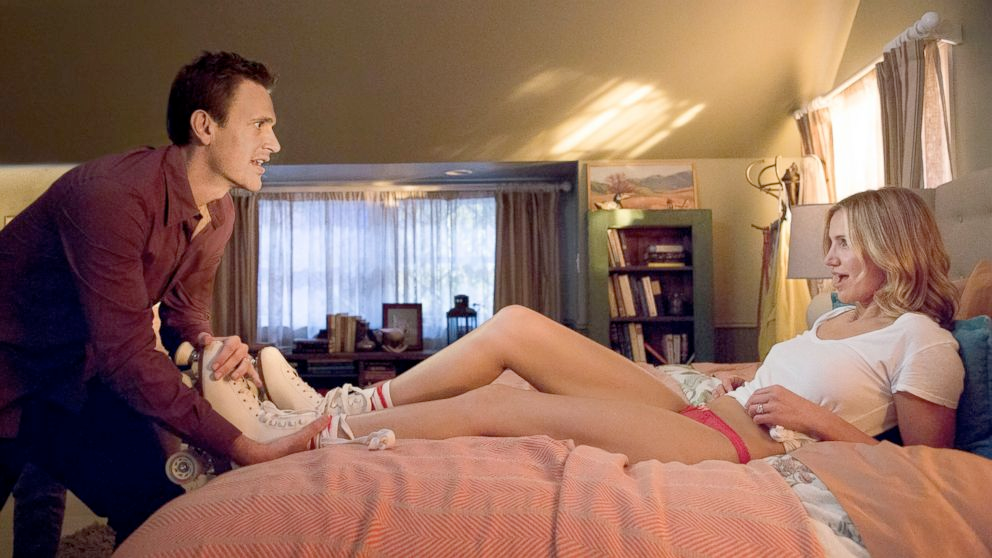
Case Study: Sex Tape (2014), w. Kate Angelo, Jason Segel, Nicholas Stoller
This film is a great example of a situation where the stakes need to be higher. Essentially, all of the risk is in the title of the tape.
So you made a sex tape? What’s the worst that could happen: it gets loose. Cool. You’d think we have a ready-made story right there. There’s a lot of cringe that can come from this situation. At this point, I’d be rubbing my hands at all the possibilities.
Add in a couple of charming actors with a track record of good chemistry (the fairly dumb, but immensely better, Bad Teacher (2011)) and it seems like something would have to go fairly wrong to send this off the rails.
And… apparently something went fairly wrong. This movie isn’t terrible, but it’s the artistic equivalent of Netflix filler content–before Netflix filler content even existed. This isn’t about ragging on the movie; I’m sure that no one involved thinks it was his or her finest hour.
The question becomes what actually went wrong here. Let’s start with a brief plot overview, then we’ll get into how to raise stakes.
Quick Synopsis of Sex Tape
Prologue: Jay and Annie meet in college and have lots of sex.
Introduction: Jay and Annie have two kids and no sex. Jay works some unnamed job that involves music; he likes to give iPads to people with his synced playlists on them. Annie is trying to sell her blog* to a “family friendly” company; she gives an iPad with her pitch deck to Hank, the head of the company. Their son, Clive, is using a computer to create a presentation for his graduation, called “Video 1.”
Inciting Incident: Jay and Annie decide they want more sex. Annie is also pushing to sell her blog to a family-While the kids are at grandma’s, they decide to make a sex tape. It turns out to be fairly long and graphic. It is filmed on one of the iPads; Annie asks him to delete it but he falls asleep having forgotten.
Second-Act Break: Jay gets a text from someone who’s seen the video. Annie is none too pleased. They decide they need to figure out who has the iPads (where the video has been synced) and recover the iPads or delete the video from them.
Rising Action: They still can’t figure out who is sending the texts, but they get the iPads easily from Annie’s mother and their friends Robbie and Tess. Robbie and Tess learn what’s happening and agree to help. Annie realizes that Hank has the iPad and that her job is at risk.
Midpoint: The four leave Annie’s mother with the kids. They go to Hank’s house, where Hank’s family is away. He is busy racking lines and listening to Slayer. Jay and Annie make up a lame excuse to go inside, where Jay pretends to have diarrhea and attempts to find the iPad only to be mauled by the family’s german shepherd. Meanwhile, Annie does a bunch of blow with Hank; they are weirdly flirtatious. Robbie and Tess get bored and come to the door; these two manage to say they’re collecting iPads for charity and actually succeed at getting Hank’s iPad.
Falling Action: Jay and Annie have an argument in Hank’s driveway. They return to the car to find Robbie and Tess having sex in the car; evidently Robbie and Tess have been watching the video on Hank’s iPad.
On taking Robbie and Tess home, Jay is confronted by their son, Howard, who reveals that he’s the one who’s been texting them. He tells them that the rest of the iPads can be remote-wiped, but that he has personally made copies and wants $25,000 to delete these copies for good–otherwise he will post them publicly online.
Low Point: Annie’s mother has gone. The kids are asleep. They decide they can’t afford the $25,000. Jay decides to watch the video to see how bad it really is; that is, whether it’s such a big deal if the video is released. After watching the video, Jay decides it’s bad enough that they need to stop Howard.
Climax: Jay and Annie grab the two kids and they go to the amateur site’s headquarters.** They drive the car through the gate, break into the server room, and begin to destroy computers. They are caught by the CEO of the site, his wife, and their security guards. The CEO and wife take pity on Jay and Annie, and told them they could simply have requested a takedown. They ask for $15,000 to pay for damages.
Extra Climax: Jay and Annie go to their son’s graduation where the son, Clive, is using Jay’s computer for the presentation. Jay is concerned that the sex video is also called “Video 1.” As the video plays, it is not the sex video, but Jay has already dived from the balcony to stop it. He crushes the computer.
Resolution: Howard gives them the final (or so he claims) copy in exchange for being able to be friends with Clive. They watch the video again, then destroy it.
*Remember those?
**I’m conscious of some of these words flagging this article in search engines, so bear with me.
Stakes, Stakes, Stakes – Start With the Logline
Let’s see where the stakes fail.
An excellent place to figure this out is to start with the logline. A good logline will make the reader want to know how the situation plays out. Let’s take a look at this one:
A couple in their 30s spices up their sex life by creating a sex tape, only to find the tape accidentally released among their friends.
(25 words)
At its core, this is a story about a sex tape getting loose. In short, we’re worried about the friends’ reactions once they see the tape and what fallout that has. This is the real cringe engine in the story idea. How this is dealt with is what interests the potential viewer.
However, since you’ve now read the synopsis, you realize that while the film might be about the tape being released, it’s not about friends watching the tape. The only two who actually see it are Robbie and Tess, and, to be fair, they seemed to be pretty OK with the whole situation.
What the film is actually about, then, is the hijinks related to preventing the tape from being released..
Remember, stakes are about considering the worst-case scenario and then exploring how the characters deal with that. What we’re looking at here is a situation where the worst case scenario is teased, discussed, cued up with a direct line to the pocket, then simply doesn’t happen.
The punch is pulled, and the viewer simply feels deflated. The writers have created a situation where we’re gagging to buy what they’re selling, and they basically refuse.
Now addressing why this is–my punt is that it’s an on-screen consequence of that uniquely American preoccupation of talking a big talk about sex while being comically prudish about actually fucking–is immaterial.
What matters is how this works in the plot, and, remarkably, how it also works in microcosm throughout the film.
Situation-Level and Scene-Level Stakes in Sex Tape
Yet “works” is a strong word here. Perhaps “stumbles along aimlessly” would be a clearer statement. From the beginning, there’s a lot of stuff we’re just supposed to assume.
Prologue: It’s possible to buy the idea that people want to have lots of sex when they first meet. One would hope so.
Intro: It’s also possible that people stop wanting to have as much sex when they’ve been in a relationship for a while. This all tracks, and is something that at least parts of the audience would understand. Those who wouldn’t are probably gibbering masturbators living in their mothers’ basements, so they might still appreciate the fact that a major plot point is at least a video of people getting it on.
So far, so good. There are a few unrealistic points, such as Jay giving out iPads randomly to friends. I want a friend who gives away iPads, but sadly these don’t really exist. I’m questioning the reality of the situation here–and as we see from the synopsis, it’s almost certainly done as a plot point–but I’ll let it slide.
Inciting Incident: Similarly with the actual attempts and failures at sex. This might be a real-life experience of one of the writers, but it’s not tied into theme, so this does not track. Remember, the more the audience questions, the closer you are to losing them altogether. Little bumps in the road are one thing, but too many bumps makes for an unpleasant ride. People will ring the bell and get off at the next stop.
The real problem comes once the tapes are lost. It’s totally fine that the tapes would be lost; otherwise there’s no point to the film. The difficulty begins with how easy it is to get the tapes back.
Second-Act Break:
Of course there’s the mystery of the random phone number texting them, but getting the tapes back from Annie’s mother and even Robbie and Tess seems a bit too simple. There’s no real risk, or even an attempt at risk. These people were totally unaware; it would be much more interesting if they had, for example, received a notification and were almost ready to watch the file. What we need here is to tease the expectation that someone will watch the video.
Similarly, Robbie and Tess are all too willing to help out. It’s good that their friends don’t really care about the sex tape business, and it’s also a nice touch, but not explored much, that Robbie has a pervy interest in the tape itself. If Robbie and Tess did help out specifically because one or both of them is motivated because they want to see Jay and Annie’s video, then there would be much more sense to the tagalong.
Midpoint:
The real narrative crimes begin, however, when we hit Hank’s house. There are all sorts of missed opportunities here, but all we get is a soup of weirdness. Hank is alone in the home for no good reason. Similarly, he is alone doing a bunch of blow and listening to Slayer for no good reason. Perhaps more inexplicably, every room has a custom portrait of Hank as a Disney character. None of this is explained or relates back to the story or theme. It’s just window dressing.
Most tragically, however, there’s no risk that Hank will see the video except what we’re told. We don’t know where the iPad–our metaphoric time-bomb–is. Jay searches for it while Annie does coke with Hank because why not? Note that the somewhat-off flirtation between Annie and Hank is never really explored here, and being in a room together with their noses in a pile of Schedule 1s seems like as good a time as any to ramp up the awkwardness–particularly when Jay could return any minute.
However, this remains a missed opportunity. All of the jokes circle around the drugs and Jay getting alternately abusing/getting mauled by a rather large dog. This ain’t Puffy from There’s Something About Mary. A dog that could actually rip your leg off attacking you is somehow less funny than a cuddly terrier on speed attacking you. It’s actually sort of scary. There’s no reason that this should work, but somehow it’s not overly grating–perhaps because of its obvious echoes of the Mary scene To the writers’ credit, both scenes do have Cameron Diaz in the next room over, so there’s that. Good effort, but no banana.
The real crime is that Hank never even knows of the video’s existence, let alone watches it. A stronger narrative would have Hank see the video and change the prevailing wind of the script. How they deal with this would be another issue: perhaps Hank makes a faustian bargain with them that they spend the rest of the film wriggling out of, perhaps Hank–with a suitable degree of awkwardness–joins the Fellowship attempting to cast the video into the figurative pits of Mordor. Perhaps Hank realizes that he’s missing out and doubles down on that awkward flirtation after seeing how flexible Annie is.
Point being, this is the midpoint. We’re expecting a major reversal and the film simply keeps coasting in the same direction. This seems off. A reversal wouldn’t be hard to do. At the very least, there could be a real risk of Hank somehow picking up the iPad and opening it. What we’re missing here–ironic in a film ostensibly about sex–is the teasing part. It’s more like “an unsatisfying fumble in the car in front of someone’s parents’ house,” except that’s a bad analogy because the parents coming out provides a more imminent sense of danger. So let’s say it’s more like “a bad fumble behind the bleachers after school with the lights turned off when you know the janitor is on the other side of the building and won’t make his rounds for at least half an hour.”
Then after everything, Jay and Annie don’t even source Hank’s iPad themselves: this is left to Robbie and Tess. Shrug.
Falling Action:
Then we get the weird semi-serious conversation in between Jay and Annie. For dog knows what reason, they’re still standing in Hank’s driveway. The conversation is neither here nor there; what’s interesting is that, as we see, this affords Robbie and Tess the opportunity to fuck in the backseat of Jay and Annie’s car. Again, a missed opportunity: we’re led to believe that Robbie and Tess watched enough of a three-hour video to want to get it on, strip, and actually, well, get it on during the window of Jay and Annie’s short conversation.
This could easily have been better played if we learned that Robbie and Tess (or maybe just one of them) had actually seen the video before on their own iPad and that their adventure in getting Hank’s back was a catalyst for them. Rather, watching two minutes of the video seems quite tame. That said, these two friends actually seeing the video at all is probably the place that the danger of the video is best expressed throughout the entire film. The fact that Robbie is weirdly interested in the video–and insists on discussing it–is also a decent move but the weirdness or awkwardness could easily be dialled up. Particularly if he starts, for example, asking inappropriate questions of Jay.
This would have to be played reasonably, however. If Robbie starts asking prurient questions about Annie coming from a place of interest in Annie, the joke could go south easily. In other ways, however, it could be played as simply cringe rather than creepy here, like wanting pointers on Jay’s Taoist breathing methods or whether he can get the number of Annie’s Pilates instructor.
And then… we find out Howard, Robbie and Tess’ 12-year-old kid, is the one who has been texting. While this is an interesting idea, it’s also played poorly. The kid basically hits them up for money and it’s at a weird place in the film. It’s more of a reversal–we realize that the real enemy is not the person we had thought it was–than the midpoint sequence at Hank’s place. Then again, a lot of this film is structurally awkward.
The problem here is that they actually take the kid seriously. It seems a bit off that two grown adults would let a 12-year-old blackmail them, but that’s what happens here. At this point, they basically say “we don’t have the money” rather than going through the effort of checking bank statements, calling parents, whatever. Put a pin in this.
Note also that Howard tells them how to delete the other iPads remotely. That takes out at least one more potentially interesting iPad collection sequence story with, well, zero effort. Also it’s weird that Jay wouldn’t know that he could delete the files remotely. Then there wouldn’t be a film, I suppose, but it seems awkward to design a film with a premise that could be got around so easily–apparently this is some sort of lip service to that fact. Honestly it just highlights the issue.
Low Point:
Then Jay watches the video and decides he doesn’t want to be seen on the amateur site (unclear whether he cares that much whether Annie is seen).
Climax:
This is taken to be sufficient motivation for them to break into the building holding the amateur site’s servers. After being caught and released, on pain of paying $15,000 of damage to the building and servers, we’re left wondering how they could easily stump up $15,000 but apparently could not come up with $25,000 before. Neither one is a pittance, but it raises an eyebrow that about three scenes after claiming they didn’t have the twenty-five grand, they end up shrugging and writing a check for three-fifths of that amount.
Now in any sane universe, the break-in, capture, and release–storming the castle, etc.–would be the end of the film. But no… we have the son’s graduation to deal with. The one chance for this film to pay off its concept will be if the son–conveniently running AV for the ceremony–manages to play their video for the audience of collected families from their children’s school.
I was rubbing my hands in anticipation of the moment. It’s never fun when something comes so easily to the protagonist. Remember, there’s no point in story outside of struggle. Think about Kingpin: it just wouldn’t be a worthwhile story–or make emotional sense–if Roy Munson simply won the tournament. Getting close and being beaten by McCracken by the tiniest margin makes the whole point about Munson’s self-belief.
So it would make perfect sense for the fires more or less to be put out by this point only to have the tape played for the families. That would be a great ending–they’d be (ahem) exposed to the world and then they would be forced to level up (or down). We’d get some sort of emotional shift whether we like it or not.
Alas, this was not to be. Jay of course jumps off the balcony at this point–if the video weren’t playing, or was the sex video and we only saw a glimpse of it–it would make some sense. Rather, while Jay is falling, we see that the video isn’t even the sex video. It’s the one Clive intended all along. So Jay jumped and broke his arm and leg for nothing. That’s sort of the feeling of the whole film: we’re teased that something spicy will happen and it just sort of fizzles out.
There might be a point to all of these blue-ball moments if the film’s theme were something like this:
Sex sounds great in principle, but it’s actually sort of a let-down and causes more problems than it’s worth.
Nevertheless, I doubt that is what the writers meant.
Last, we have Howard surrendering his copy. I mean I thought we rid ourselves of this problem with the visit to the amateur site’s servers. But sure. Fine. OK. Howard gives up his USB stick, although we have to take his word that he doesn’t have another copy somewhere.
Then we get the images from the tape itself and watch Jay and Annie destroy the USB. The violence with which they do this means we need to revise the theme again:
Talking about sex is lots of fun (unless it’s with Robbie), but when confronted with actual sex we must kill it with fire.
This seems to be much closer to the intention of the writers, whether conscious or not.
A Better Wrap-Up — Let’s Fix This Film
Since this is about how to raise stakes, let’s actually raise them.
Notice how Howard giving the USB back comes after Jay has jumped off the balcony and damaged himself.
Now here’s a modest proposal. Even if all the other stakes remain criminally low, you could add a good two-points-out-of-ten by doing the following:
>Have Howard give Jay and Annie the USB before the graduation ceremony. If Howard was still an issue–and, to be fair, I didn’t take it that he was–then this would all be sorted. All the fires definitely put out at this point, or so they think.
>Then, Jay and Annie watch the tape–conspicuously copying it to the desktop of the computer. They are aghast. They destroy the USB with violence.
>Only then, go to the ceremony and realize that the computer they watched the tape on still had the tape on the desktop. Then THE ACTUAL SEX TAPE gets played, if only for a moment.
>Honestly, just a quick reaction shot–Diaz and Segel are both excellent physical comedians–then credits.
If we had to go farther back, the next point to address would be putting Hank much, much closer actually to watching the video. That is, it’s in his hand with his finger on the button–even if he doesn’t see it–rather than in a drawer in his foyer. The remaining points could be deal with piecemeal in a couple of fairly simple drafts.
Conclusion
The key point I’m making here is that things need to get close to the shit hitting the fan. Over. And over. And over. Consider what the worst thing that could happen is, and tease that actually happening.
Eventually, let it happen and see how the character reacts. That is story. How the protagonist(s) deal with this problem illustrates theme. It’s unsurprising that a film that seems to have no (intentional) theme also has such problems with its stakes.
If the writers had established a theme during the drafting process (it might not actually be clear for the first couple of drafts), then they could easily have gone back and adjusted individual points to be fractal reflections of the theme.
Almost certainly this would have ended up improving the problems with the stakes. Imagine a theme along the lines of this:
How you deal with the worst-case scenario defines your strength as a person.
In this case, we could have the “worst-case” scenario for each individual scene come to pass.
That doesn’t mean everything would be life-or-death or that they’d have to play the sex scene over and over, but we would easily get a lot of near-misses and watch Jay and Annie grow through the trials. This is how to raise stakes.
As it stands, the couple just seems prudish. But hey, it’s an American film. All talk and (ahem) no action. At least not without sufficiently shaming oneself over said action.
Exercises:
First Case, Worst Case – Plot Stakes
Make sure you’re clear on your logline.
Next, think about what the absolute shittest, most catastrophic thing that the logline implies might happen. If not obvious, this is quite literally (not figuratively) what people are waiting to see. Don’t make it easy for your characters.
Think about your story in these terms: “Terrible outcome X happens, so the characters are forced to do Y to manage it.”
If you can express the story in these terms and still make it sound watchable, you have good stakes. If you get something like “Terrible outcome X is teased, but sorta kinda never really happens so characters do silly things and actually we don’t care what happens by the end” then, naturally, you might have some stakes to raise.
The Big Red Button – Scene Stakes
Ever wonder why the world seems like it’s on fire these days? Among other things, one contributing factor is that there are a fair few half-bright thugs with access to the nuclear codes. When these ass-clowns’ fingers hover over a Big Red Button, we all squirm.
Your exercise is to figure out what your script’s Big Red Button is. Or, for that matter, what each scene’s Big Red Button is. Your job is to get the finger hovering over the button, figuratively (not literally), as quickly as possible.
Think about Sex Tape: Hank was never even in danger of seeing the video through the entire midpoint sequence. That’s why it’s a letdown. If he discovered it and were ready to press PLAY, we’d have a scene.
Here’s the formula:
Think about a place near the midpoint where your worst case scenario might happen: someone’s finger is over the Button.
To make it clearer, make the pressing of the Button one physical action away–but someone else’s finger is the one hovering. Your protagonist understands this and is absolutely shitting herself.
No more exposition. You can play with characters’ physical location, timing, and choices. However, nothing new can be introduced (at least nothing that wasn’t gestating there like the alien in Kane’s chest).
Make the decision visible. Make your protagonist sweat. Could one false move jeopardize the protagonist’s work up until this point? Consider how this makes the protagonist’s choices until this point seem really fucking dumb right now.
Then–and this is the key–figure out how to avert the absolute worst case scenario, yet still send the protagonist’s plans reeling in a totally different direction.
This moment is a game changer–one the protagonist finds none too welcome–without actually blowing the planet sky high.
Commitment = Escalation – Character Stakes
One of the problems with Sex Tape is that it’s so chaotic. A lot of the stuff happens “just because,” not following on logically (or even emotionally) from what’s come before. In essence, it escalates through chaos.
Rather, you want to escalate through commitment.
You want your characters to make choices that are, effectively, irreversible.
As you build the first half of the script, make sure you have these main points:
- A choice that is dumb but reversible. (Inciting Incident)
- A basically irreversible choice that sets them on a particular course. (Second-Act Break)
- A choice that blows up in her face and permanently alters how others perceive her. (Midpoint)
The trick will be to figure out for each of these three points what the character gives up to make each choice, and why the character chooses to plow ahead regardless of the consequences.
You’ll know you’ve nailed this if something is set in motion by the Midpoint that means going back to life-as-usual from the beginning of Act I is not just a “nice to have,” it’s simply and demonstrably no longer possible.
If you are working character change into the script, that means the character’s fundamental identity–whether socially or at least to herself–must have changed.
Notice how Jay and Annie end up back where they started at the end of Sex Tape, no consequences. Don’t do that.