Four Arguments Against the Hero’s Journey for Screenwriters
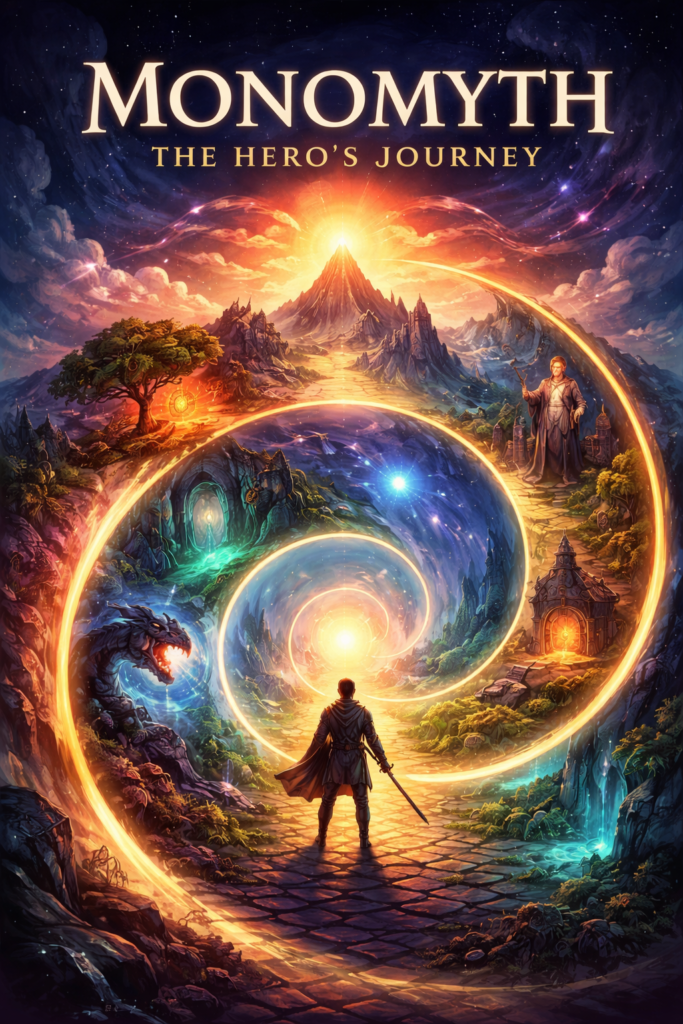
(NGL: not a film I’d watch)
Introduction: Template Over Story
The first thing I tell new writers is that templates are good for editing, not for writing.
Storytelling, despite many books that would have you believe differently, is an issue of trying things and seeing what works in practice: casting a line and seeing what bites, not building a carp out of Lego blocks and calling it a fish.
Let’s use the famous Hero’s Journey as our example. As the famous story goes, Joseph Campbell read myths from numerous different cultures and distilled the commonalities of these myths into what he referred to as the “monomyth”: a single base structure common to all these stories.
The Hero’s Journey is, for short exegesis, as follows. It is largely divided into three “acts”: Departure, Initiation (often split into two parts, divided at the Midpoint just as one tends to see in screenplay), and Return.
- Departure: Call to Adventure, Refusal of the Call, Supernatural Aid, The Crossing of the First Threshold, The Belly of the Whale
- Initiation: The Road of Trials, The Meeting With the Goddess, Woman as the Temptress, Atonement with the Father, Apotheosis, The Ultimate Boon
- Return: Refusal of the Return, The Magic Flight, Rescue from Without, The Crossing of the Return Threshold, Master of the Two Worlds, Freedom to Live
This of course has been simplified by innumerable people, perhaps most famously Christopher Vogler, who condensed the Hero’s Journey into a Disneyfied version responsible for early-90s animation such as The Lion King.
The journey itself is rather complex. While there’s a lot of lip service paid to how George Lucas used The Hero’s Journey to construct Star Wars, there are demonstrably quite a few parts of the Journey left out of the original film (one might make a slightly better argument for tracking the Hero’s Journey across the first three films). A better example of a film that tracks all the beats of the Hero’s Journey is The Matrix.
The problem here, of course, is not whether the Hero’s Journey template is used or not used. Simply using it does not make a film good; The Matrix might be an excellent film, but there are thousands of also-ran films (and even more unproduced screenplays) that also followed the Hero’s Journey beats in lockstep.
One: Confusing Template for Story
What we face here, then, is a classic problem of confusing the template for the story. Or, to paraphrase Alan Watts, eating the menu rather than the meal.
It is important not to get overly fixated on using the template, because the template is not your story. Sure, the template can help in editing to help identify or rectify when something is genuinely not working. However, adding or subtracting simply to make your story match the template is a recipe for a stilted, broken, formulaic film.
The real questions to ask, as a writer, are “what is missing from this story” or “what would make this story better?” Think about what you can either add or subtract to get the themes and emotions across more cleanly. It’s often just as much about subtraction as it is addition.
The problem with templates like the Hero’s Journey is that they take story that is organic and try to distill this into a repeatable formula. The problem faced here is a similar one to the measurement problem in philosophy of science: any measurement is by nature reductive. That is, the measurement describes one isolated point within a broader, more complex system. Appropriate measurement at best describes a system,* but it is not the system itself.
Furthermore, because measurements are inherently reductive, it is arguably a fool’s errand to attempt to build an organically complex system merely from a group of measurements. At best, this proposes a connection between a group of isolated points but it ignores the organic space between the points. Now it is possible that these gaps will be filled by a talented writer, for example in the way that Glenn Gould “fills in the gaps” left by the piano transcription of The Goldberg Variations. Of course it is equally possible that the gaps will remain and the story will appear broken and stilted in the hands of a lesser writer.
This is the same reason that, for example, building an artificial brain that functions like a human brain is such a difficult problem: certain principles might be isolated, but by definition–given how little we understand about how the brain actually works–we simply don’t know what we don’t know. The points we have are necessarily reductive, and it may at the end of the day merely be wishful thinking that we have isolated enough of the correct points to develop any useful emergent properties that “fill in the gaps.”
Of course someone in the peanut gallery is bound to propose that our solution is “more data points,” whether that be the Hero’s Journey beats, Blake Snyder’s 14 beats, or John Truby’s 23 beats, or whoever has decided she has the correct number this week. The problem here is that it’s not an issue of whether “more beats” makes a better story. This, after all, tracks with the line that big tech’s PR has sold us: everything is computable, so everything can be computed.
The problem is that this itself is an inadequate and reductive way of thinking. It literally (not figuratively) ignores any form of intelligence that is not based on formal logic, such as scientific hypothesis or commonsense inference. As Angus Fletcher puts it, “The more that we believe that thought is based in… pattern-finding and data calculation, the more that we equate intelligence with computation, neglecting and even denying the neural operations of narrative.” [1]
This is how we end up with thinking “more beats, better story.” We could have a vast number of beats–and this is, by chewing up reams of stolen data, largely how LLMs work–and we might have something that largely approximates a story, but it rings hollow. This is something people can recognize intuitively–analogously, how quickly can you tell that a post is AI-written?–but will admittedly require a bit more thought on my part to codify. Given short shrift, it lacks a certain organic complexity that is easily discernable even to the untrained reader.
Money people want to believe in templates because it means they don’t have to pay squishy, emotional writers. Remember, Hollywood has been trying in one way or another to disenfranchise or simply eliminate writers for over 100 years at this point, but it never actually works to do so because, as Bill Goldman put it, “nobody knows anything.” That is, there’s no telling what will actually succeed at the end of the day. One thing we can see empirically is that success is not correlated in the slightest with what money people expect to succeed.
Others perhaps simply unconsciously rely on Peirce’s “Argument From Authority,” which makes sense to some degree. After all, we’d all love to have a person who knows how things work tell us, well, how things work. The problem here is that what gives someone authority is not necessarily clear. Sometimes working writers will write how-to books, but templates tend to be the purview not of working writers but late-night infomercial types.** Even Campbell is a bit of a joke in the academic sphere.
In the end, it’s a nice fairy tale to say that we can use a template to construct a good story. At its most benign, this is simply putting the cart before the horse. Templates can be helpful for editing, but they are very dangerous when used to construct a story, or, alternatively, when a story is forced to hew to the template at the expense of inherent organic qualities that may actually work.
*It is entirely possible, of course, that one might be measuring the wrong thing.
**Snyder, to his credit, was a working writer; his book is more nuanced than simply the beats, but it’s fairly rare for people to do more than print out a copy of his beat sheet and try to match it.
Two: Change as a Goal
Another fundamental problem with the Hero’s Journey is that it assumes that film relies on an (overt) change for the protagonist.
At this point, we’re browbeaten into assuming that the protagonist needs to change, so change itself seems like a fundamental part of a film script. That’s demonstrably untrue: there are any number of excellent films that provide no change for the protagonist.
In the case of a noir hero such as Philip Marlowe, Sam Spade, or the Dude, the lack of change is actually part of the formula. For a “traveling angel” such as James Bond or Mary Poppins, someone else might change, but the protagonist doesn’t change. In classic horror films such as Night of the Living Dead or The Texas Chain Saw Massacre, no one is put into the film’s crucible to learn “life lessons.” Films like La Haine or Gaspar Noë’s Climax make their point perfectly well through senseless tragedy. Many anti-hero films don’t even bother to offer potential for change: take The Wolf of Wall Street as an example unless you’re willing to take “How do I do the exact thing I’ve always done except without running afoul of the FBI?” as change.
This doesn’t stop from Snyder-drunk Hollywood from enforcing change on every script it sees. Think Netflix filler content. This is how cack-handed life lessons get bolted on to films such as Evil Dead Rise (2023), which just makes what otherwise could have been a competent exercise in jump-scare horror into a shitty after school special (“Don’t get pregnant, kids, or your nephew will accidentally summon a demon and by the end of the night you’ll have fed your family into a wood chipper.”). Spare me.
So, if we can 1) easily point to numerous excellent films that don’t have change, and 2) we can easily point to films that suffer from unnecessarily added change, then it’s a fair punt to conclude that change isn’t actually necessary for a good film.
Now understandably this may be difficult to understand thanks to the modern information economy rotting everyone’s brain, so please resist the urge to burn me at the stake here: I am categorically NOT stating that films ought not have character change. If character change benefits your story, great. What I am saying is that it’s not strictly necessary that a film have character change.
So, if we’re willing to accept that not all films need character change, and with the Hero’s Journey we’re looking at a template that effectively requires character change, then it follows that this template doesn’t work for the sorts of films that simply don’t benefit from character change.
In your writing, then, it’s important to understand what is working for your story and what isn’t. If you have a story where character change is necessary, have at it. But don’t force a life lesson into your script. This isn’t 1990s Disney animation.
Three: The (Masculine) Hero’s Journey
Of course you may have heard that the Hero’s Journey is “a masculine form of storytelling.”
There are numerous reasons for this, from the fact that Campbell used exceptionally gendered language in his Hero’s Journey model, that–at least according to hearsay–Campbell’s attitude toward women was somewhat less progressive than Genghis Khan’s, or even the fact that there’s basically an (ahem) “enter the cave, splooge, exit the cave, fall asleep” structure to the broader Hero’s Journey.
The problem here is that we may just be running into one of those things that Theory-addled Humanities people say to sound smart. That’s not to say that the Hero’s Journey isn’t masculine; it’s just to say that those people are dumb.
The fact that it’s masculine might not be a bad thing overall. Simply being “masculine” doesn’t necessarily mean “bad.” For that matter, it doesn’t even mean “male.” It is worth remembering–and credit to the Humanities department for this one–that “masculine” and “male” and “feminine” and “female” are better considered distinct categories, particularly in storytelling.
That is, there’s a good argument that some very excellent films have been made with a putative Hero’s Journey structure and female protagonists; a case could be made for Sarah Conner in the original Terminator or Katniss Everdeen in The Hunger Games or Ripley in Aliens (less so the first film) any number of other females in adventure situations.
Maureen Murdock has developed an intriguing antidote to the male-centered, linear Hero’s Journey. Murdock’s Heroine’s Journey provides a template of a more cyclical, interior female-centered story focused on the changes that contemporary women go through. This model is well worth looking at, but the subject for its own article.
Campbell, for his part, was allegedly dismissive of the work of Murdock, his one-time student. By Murdock’s account, this was Campbell’s reaction: “Women don’t need to make the journey. In the whole mythological tradition the woman is there. All she has to do is to realize that she’s the place that people are trying to get to.”
Nevertheless, remember that we’re not talking about only a masculine model or only a feminine model. One might work for a certain story, while the other works for a different story. Importantly, these aren’t even the only two ways to tell a story. They might be helpful to analyze your story, but remember, any model is–by definition–reductive.
What’s important to bear in mind here is that the Hero’s Journey is one type of structure: one that is extremely overdone, particularly in recent decades in Hollywood. The tide seems to be turning, however, as longer, more ambiguous, more challenging narratives are, mercifully, starting to appear once again.
Explore different ideas, but figure out what works specifically for your story. Eat the meal, not the menu.
Four: Disingenuous PR
In principle, the whole idea of the Hero’s Journey, or in Campbell’s terminology, “the Monomyth,” is that it is determined from the commonality of a plurality of ancient stories. While there is little reason to doubt that Campbell did, in fact, look at a bunch of old stories and figure out what was common among them, it’s important to consider how much he left out.
Two points to consider here:
First, who’s spent time in academia is familiar with the concept of “cherry picking,” or relying only on the information that supports one’s thesis while discarding anything that does not. In principle, a reasonably good academic work should consider, address, and possibly refute potential arguments against its thesis.
(Not that this happens particularly often in practice, of course, because academic writing–like anything else–is mostly ill-reasoned, largely unreadable rubbish.)
Given that Campbell largely says “this is how things work” and leaves his argument there without addressing arguments to the contrary, one must get a bit suspicious about what these arguments to the contrary might be. Essentially, Campbell positions himself as an authority. That doesn’t inherently make him wrong, but–and I’m with Peirce here–it sure as shit doesn’t make him right.
Second, consider the classic fallacy of survivorship bias: if you’re judging a group based on the surviving examples of that group, you can’t judge what the group was like before the non-surviving examples were exterminated. In other words, you might think that music was better in the 60s,* but you’re not hearing the absolute garbage that flooded the airwaves. Essentially, evolution, taste, and other forces have made a particular selection for you somewhat blindly. You might think of it as a Dawkins-approved form of cherry picking. Whatever the case, it remains powerful.
And yet somehow–and don’t forget that Campbell himself called this the “Monomyth,” as in the one important myth to the exclusion of all other myths that didn’t necessarily jibe with his privileged, white-ass, early-20th-century male point of view–this ended up being taken as literally (not figurative) the only way to tell stories.
It’s hard to believe that anyone actually took it this way, but hey, Hero’s Journey films seemed to make money for a while. Perhaps that’s what always what it boils down to, but remember that money doesn’t buy taste.
Thankfully it seems that even Hollywood is growing out of this with the success of filmmakers such as Yorgos Lanthimos, Martin McDonagh, and Luca Guadagnino, and others. That is, of course, not to deny the European heavyweights, e.g. Joachim Trier, Ruben Östlund, Julia Ducornau, or Céline Sciamma, to name a few, who never subscribed to this malarkey in the first place.
*OK fine it was.
Conclusion
In case something upset you here, please don’t throw the baby out with the bathwater. If you’re trying to do a story that can be framed as an adventure with notable character change, great.
(See if you can follow these beats in Crispin Glover’s inimitable What Is It?)
Nevertheless, if you’re working on change, you might be better suited to look at John Yorke’s five-act structure, or even Dan Harmon’s “story circle,” which is arguably a modernized Hero’s Journey. Sometimes holding up a template is just what you need to see where your story falls flat; use templates for editing, not for writing drafts.
The point here is not to pick a structure and stick to it at the expense of your story. Rather, let your story breathe and exist and figure out what works for your own story. Look at other films and see how those have overcome similar problems.
Be your own judge. Don’t fall for claims of authority.
——–
[1] Fletcher, A. and Benveniste, M. (2025). Narrative Creativity. Cambridge University Press.
NB All links affiliate