Metaphor for Screenwriters
Let’s get it out of the way right now: metaphor and theme are definitely a topic for revising scenes, not for writing them in the first place.
There might be a few rare exceptions. Primary among these would be situations where you have, for example, a science fiction scenario that is intentionally designed as a metaphor for a current social situation.
More likely, however, you’ll have a scene that serves a particular function. You might even have a fairly boring version of that scene that you’ve written mostly to move the characters from one position to another–a placeholder, as it were. It might be a boring drive, or it might be painfully dialogue-heavy. At least it’s on the page. We can fix it.
The goal, in this case, is to take a boring placeholder scene and give it a bit more kick on a subtle level. Make it something that tells us something about character or theme through situation or action rather than through words.
A good scene gives us information about characters through the fuckery in which they find themselves embroiled, and what they do and say to un-fuck said fuckery.
This is where Theme comes in. The reason this is for rewrites is primarily that Theme itself is largely unclear until at least a vomit draft. [1] It might even take longer than that. Eventually, however, it will become more obvious what the script is trying to say.
That’s when we can go back and weave some metaphor in.
NB: If you’re working on only this one scene, you can cut the process short and think about what the deeper meaning of the scene itself is trying to say. Think about a pithy motivational poster statement like “Never give up!” or “The pain you feel today will be the strength you feel tomorrow.” Hopefully less gag-inducing, but try to figure out what the scene wants to propose and fit it into one sentence so that we can progress to the next step. That’s all I’m saying.
Metaphor for Screenwriters – A Quick Definition
For a quick jaunt back to seventh-grade English class, a metaphor is a comparison that doesn’t use “like” or “as.” If it does, that would be a simile. The other thing about metaphor is that metaphor, thankfully, doesn’t have to be spoken. The presence of “like” or “as” tends to imply speech and, of course, we’re talking about film as a visual medium.
While it’s not impossible that a metaphor can involve spoken language, the best metaphor in film tends to be visual, situational, or story-based. That is, good metaphor in film tends to go unstated.
The Purpose of Metaphor for Screenwriters
All that said, it might be worth addressing the point of all this.
Obviously (or not), screenwriting is about telling a story. This brings us to the point of telling stories in the first place; in a broad sense, stories are a way to bring across a message without bludgeoning people over the head with it.
Let me address this with an example (see what I’m doing here?): think about telling a child not to play in the street. The first thing the child will do, naturally, is to go play in the street.
However, telling the child terrifying, eldritch stories about the monsters who live in the public drain system and emerge to disappear children who would dare to challenge adults’ edicts might actually do more good.
This is because stories are important. A good story holds much more weight than a simple order.
As storytellers, we are trying to get messages across as much as generally trying to express ourselves. As much as any of us claims to “have things to say,” we need to define that thing–in as efficient, pithy a way as possible–and bring that throughout the script in different ways.
The beauty of metaphor is that we can continue to impress a point on the audience through story without the stories need not literally (not figuratively) be about the topic they are about on the surface.
Let’s look at different types of metaphor.
Metaphor as a Result of Censorship
Censorship used to be a big thing. I am no fan of censors in general, as I believe that people whose buns are professionally too tight have a tendency to overstep. [2] Nevertheless, I have developed a grudging respect for censors’ place in the world as I have learned more about their place in the history of film.
Arguably, censors and their bizarre edicts [7] are responsible for some extremely creative metaphors. Interesting ideas were pushed into the quasi-abstract merely because these ideas, if dealt with in an obvious way, would create stinging hurts in the butt of one holier-than-thou censor or another.
Just as censors have a hard time with satire because censors are, by definition, humorless, they also have a hard time with abstraction. This stands to reason given that much humor requires a certain degree of abstract thinking.
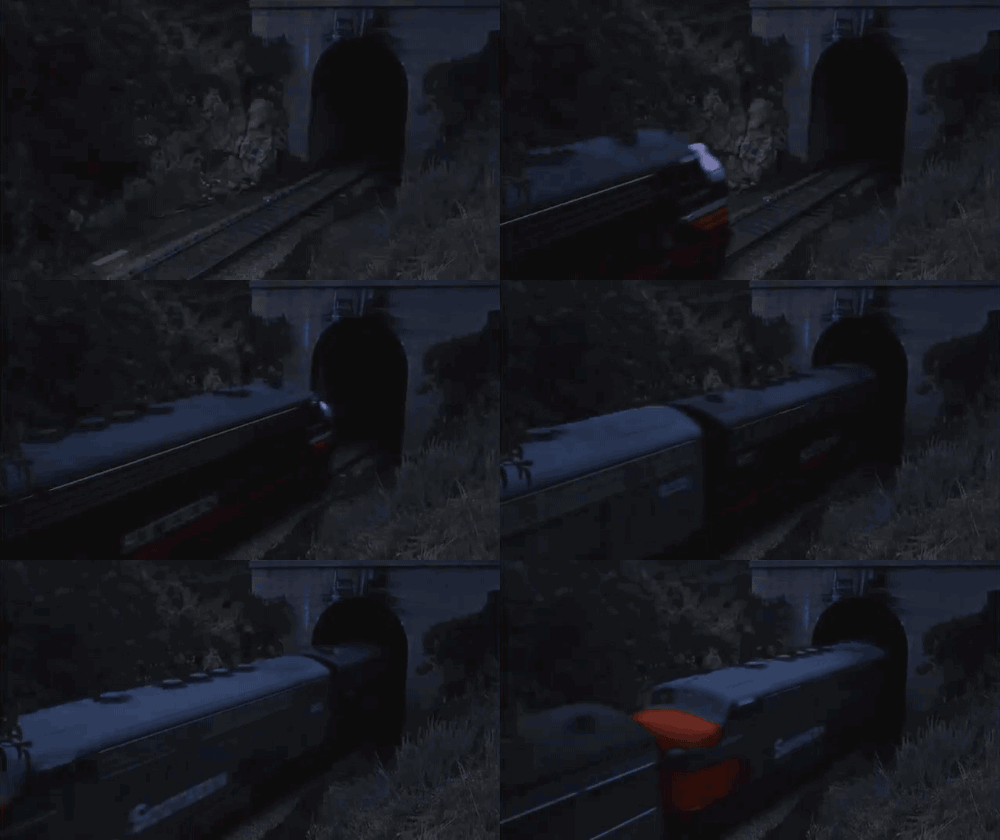
Just as with conspiracy, this can be interpreted in extremis; humorous as it might be, I doubt Gore Vidal’s interpretation of “Rosebud” in Citizen Kane is actually what Welles had in mind. A somewhat less subtle example would be the train entering the tunnel in North by Northwest. [4]
Watch the surprisingly sex-positive romantic comedies of Billy Wilder for any number of clever ways around censorship: consider Junior’s (ahem) restless leg on the boat in Some Like It Hot.
Metaphor as Object
This can happen multiple ways. The Maltese Falcon in the eponymous film is an object. As a classic MacGuffin, it is the thing that people are running around the film chasing after, but the object itself comes to represent the mania surrounding the object.
Similarly, in The Big Lebowski, the fact that the money–the MacGuffin–gets replaced by Walter’s dirty underwear (the whites), then turns out never to have existed in the first place, is surely a metaphor for the meaninglessness of the concept of a MacGuffin in the first place.
In The Apartment, the cracked mirror connects Baxter and Fran, two people whose self-image is similarly broken. In the same film, the key to the Executive Washroom becomes a metaphor for Baxter becoming the sort of asshole who would use his subordinate’s apartment as a love nest; hence, when Baxter decides to become a mensch at the end of the movie, he gives the key back to Sheldrake.
Metaphor as Situation
In Triangle of Sadness, the pettiness, frivolity, and capriciousness of the rich literally makes them ill (the bad oysters). Their shit goes everywhere on the boat. The middle class crew are generally able to keep their white uniforms tidy by leaping over the literal (and figurative, I suppose) rivers of shit. The below-deck working class, of course, are the ones who are tasked with cleaning up the wealthy people’s shit. The wealthy shamelessly shit all over those of more modest means, which is literally what we see here.
The film Under the Silver Lake is ultimately about the thoughtless exploitation and objectification of women by LA and the entertainment industry. In a classic scene, Sam and his friend Bar Buddy (sic) discuss Sam’s paranoia and persecution complex–all while using a drone to peep on an undressing woman. In the middle of taking her clothes off, the woman bursts into tears. Men objectify and exploit women for their own entertainment, which is literally what we see here.
The film The Square (by Ruben Östlund of Triangle of Sadness) uses the famous “gorilla scene” as a set-piece. The entire film is about how the middle classes avoid all responsibility when caring for the disadvantaged. This scene shows the middle classes, well, avoiding responsibility for helping the clearly distressed woman whom the “gorilla” has taken hostage.
Metaphor as Language
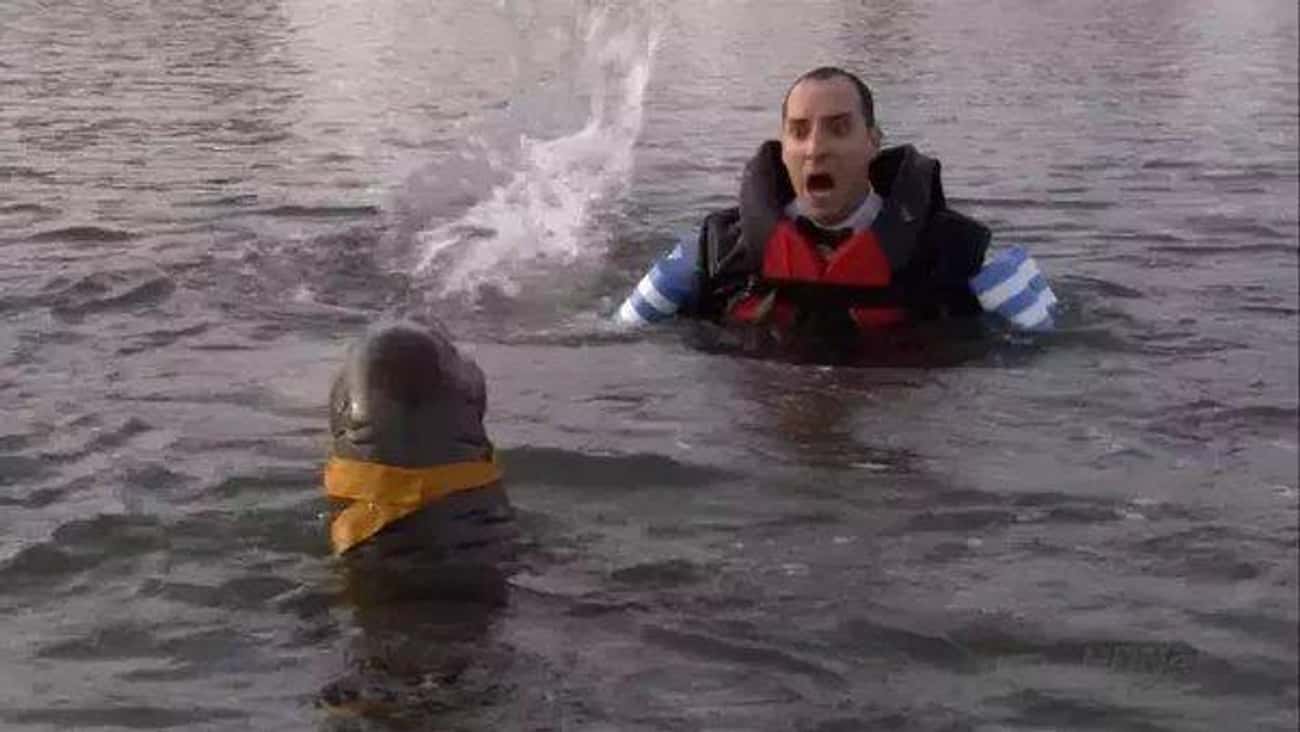
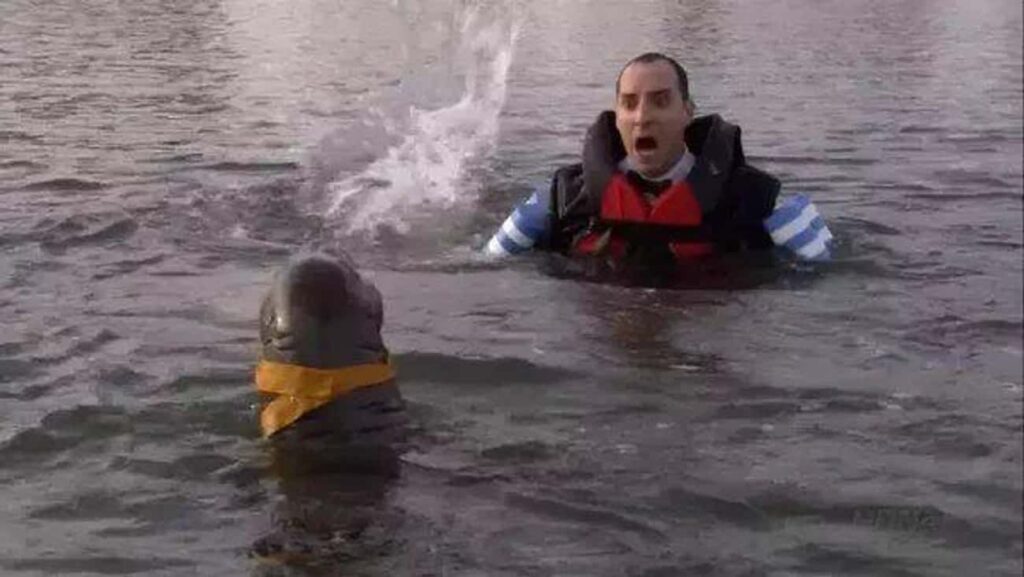
In Arrested Development, Buster is henpecked by his mother, Lucille. Elsewhere, his brother Gob has bought a trained seal (“sealed the deal with the seal dealer,” naturally). Unfortunately, Gob’s newly acquired seal escapes, or gets loose. Of course when Buster defies Lucille and runs into the ocean in a dramatic attempt to prove his independence, he is attacked and his hand bitten off by the loose seal. Not to put too fine a point on it, but “loose seal” and “Lucille” is not a mistake here.
In The Simpsons film, Homer ends up swinging on a wrecking ball between a mountainside (a rock) and a western-style bar called “A Hard Place.” It’s never literally stated, but he finds himself–wait for it–”between a rock and a hard place.”
Of course broad comedy, particularly that with an intellectual bent like The Simpsons (consider the farm team for their writers), loves this sort of reference, but it’s not simply relegated to wink-wink, nudge-nudge jokes.
It’s no mistake that there’s so much talk about “the flock” in The Witch, be that the church or the family unit. Consider Matthew 25: 31-46 and the Parable of the Sheep and Goats. The “flock” is an appropriate word for a church congregation, but it brings to mind the idea of sheep. And then there’s Black Phillip, who is fairly obviously a great big fucking goat. So it’s not a huge stretch, metaphorically, to imagine that listening to the talking goat would–so to speak–place one on the King’s left side.
Metaphor as Structure
In Park Chan-wook’s No Other Choice, we could harp on the refrain of people saying that they have “no other choice” when doing terrible things. Man-su, an experienced paper-factory worker, is told that his company has “no other choice” but to let him go. We repeatedly hear that Man-su, through his travails and experiments in murder, also has “no other choice.” Only after Man-su finally (ahem) secures the one available paper job going, realizes that his job is to be the human foreman for a fully-robot factory. We’re told by the company creating the robot factory that that’s the way of technological progress.
In this case, in some sense we have the words, but perhaps we also have the fact that technological advances put strain on not just industries but people: the paper industry suffers because of technology just as its workers do. People need less paper because they look at screens. Paper factories need fewer workers because of less demand plus robots. Man-su, as a paper expert, is in a position that seems to have no workable outcome: he’s too old to retrain and if the industry in which he is a specialist effectively disappears, he is–or so he feels–useless as a human being.
The inexorable march of “progress” has its victims, and Man-su is one of them. Surely, it would seem, there is always “another choice” when it comes to killing someone–unless perhaps with the exception that that person is an immediate threat to one’s own life. Not to justify Man-su’s behavior, but the film makes an interesting case for how supposed progress pits would-be colleagues against one another in a form of mortal combat.
That is, everyone always claiming there’s “no other choice” defines the outcome of the film. By the end, for all the fucked-up things that have gone on so far, it seems that Man-su has little option but to roll with it and live his life convincing himself that he, too, had “no other choice.” Whether the audience is convinced is another story, but that is of course the point.
It’s also worth taking a look at Triangle of Sadness here: the film is split into three parts with three major locations; there is a love triangle; the triangle of money, love, and power; the triangle of the wealthy, the middle class, and the working class, etc. Consider how each of these themes are pitted against one another within the film.
The Big Lebowski has a slow pace and easy humor. It seems like a gentle film in many ways. It doesn’t have a particularly large climax, with each of its five acts having a rise and fall but no major life-or-death issues (except Donnie) and few actual stakes except the rug. Nevertheless, it is an exceptionally intelligent noir where all the hyper-complicated plotting actually lines up (which is unusual for the genre). It’s just that we’re able to digest it because of the pace and the ease of the characters. The film, like the Dude, abides. The structure is part of the message.
Now this can obviously be taken too far. A colleague once suggested to me that the reason Donnie Darko shits the bed after the midpoint is because “it’s intentional, to reflect the shattering of Donnie’s psyche.”
Or maybe it’s just bad writing.
With that in mind, a structure that provides a metaphoric reinforcement of your theme is great, but don’t be tempted to fob off some shit that desperately needs a couple more rewrites as “I’m trying to write a mental breakdown.” You’ve been warned.
Conclusion
This list is by no means exhaustive, and I acknowledge that in many cases it’s done on the level of the whole film. Nevertheless, think what you can do scene by scene. There are ways that you can take any of these types of metaphor and roll them into a single scene.
So consider what you’d do to sneak a crass idea into your scene without actually pulling someone’s trousers off (it’s more entertaining that way). Consider how an object, or even a phrase, can be used as a metaphor. Consider how a situation can be a metaphor for something else, or even the structure of the scene can reinforce the message of the scene.
Remember that you probably don’t want to do this all at once–we can’t all be Ruben Östlund–that’s very difficult to accomplish, and with metaphor a little goes a long way. But add in just enough and you’ll add immense depth to your work.
Exercises:
Exercise 1) Visual Metaphor
What we’re trying to do here is to translate a thematic statement into some sort of visual metaphor that goes unstated.
First, figure out what the point of the scene is. What is the unstated theme of what’s going on here? It should be a short line, like “honesty is the best policy” or “you become the thing you fear” or “power corrupts” or whatever.
Second, go through and remove any dialogue that says this directly (if there is any, of course).
Third, redesign the action so that we get a visual representation of this idea or sentence. It doesn’t necessarily have to be in the action, but it could be something going on in the background. For example, for “power corrupts,” it could be something like having a power surge destroy a television, or excessive heat in an oven ruining a cake. Heavy-handed as it might seem, if it’s something that’s happening as a distraction from the dialogue while never actually stated, you’d be surprised at the impact that it has.
The dialogue can be mostly similar, but the idea is reinforced by the action/situation.
Finally, make sure that the dialogue remains roughly similar–only take out direct references to the theme. The point here is to get comfortable
Exercise 2: Object as Metaphor for Screenwriters
In this case, the idea is to use an object to represent something metaphorical–but you’ll lose points if you directly call attention to it.
First, figure out what’s going on thematically–just as we did in the previous exercise.
Second, think about something subtle that naturally exists in the scene–consider the broken compact mirror in The Apartment–and consider how this can be used to reflect the theme.
Third, consider how this object can change state or otherwise be affected during the scene so that the audience’s attention is drawn to it. This is particularly true if there’s something in the background. E.g. a senile, syphilitic madman of a politician giving an unintelligible speech while a building symbolically representative of his government is being razed in the background of the shot–just make sure the razing is never mentioned.
The point is to highlight it or draw attention to it, but as soon as it’s stated, the game is over. That would be like explaining why a joke is funny.
Exercise 3: Structure
Consider the shape of the scene.
First, as ever, identify theme–but particularly focus on thematic conflict–within the scene.
Second, consider how this might apply structurally. Here are a few examples to get you thinking:
Repetition: You could, for example, repeat some sort of action so often that the audience begins to question its significance. Remember, it probably ought to be significant, or this becomes a bit silly.
Depending on where the scene is trying to go, this behavior or action becomes more morally questionable throughout the scene.
False Choice: You could also give different choices to a character, each of which lead to the same conclusion–which is the theme.
Geometric: a triangle or quadrangle of characters to represent a hierarchy or a sort of interplay, or perhaps an up-down distinction. Consider the lower classes living under ground-level in Parasite.
Symmetry: the scene circles back to an image similar to where it began, but with a notable change. That change–whatever it might be–is representative of your metaphor. This can also be as simple as frantic action using handheld cameras rather than dollies, etc. but try to stick to things you can do on the page.
Third, map out the beats of the scene. Step back and ask yourself: “If the structure itself made the argument, what shape would that take?” Rearrange your beats accordingly.
[1] The ugliest of rough drafts; just what you, well, barfed on the page to get to the end.
[2] Which is by no means to suggest that letting a shameless white supremacist run a major social media site is reasonable pushback; the “overstep” remark would require a reasonable sense of decency–and, let’s be honest–shame in society that evidently doesn’t exist any more.
[3] Bear in mind that most of these people are surely shocking perverts in their private lives.
[4] See the first Austin Powers film for a great send-up of this.
[5] Metaphor for Screenwriters for SEO!