How to Create Suspension of Disbelief for Screenwriters
As a big fan of speculative fiction, I have long been interested in determining where one can draw the line between believable fiction and the sort of fiction that disturbs the audience to the point where they’re knocked out of the story.
That is, how to develop and maintain what Coleridge called suspension of disbelief.
As master of speculative fiction Neal Stephenson puts it: “The key to any storytelling is getting the readers to suspend their disbelief. And there’s all kinds of triggers and little tells that can break that… and once it’s broken, it’s really hard to get it back… Somebody will just close the book and not pick it [back] up.”
On one hand, it might seem that suspension of disbelief is only valid for people who are writing science fiction. “But this is a romantic comedy,” or “this is historical fiction,” or whatever a writer might complain to wiggle out of responsibility.
If you think about it–and surely Coleridge wasn’t talking about science fiction*–all fiction involves suspension of disbelief,** at least insofar as we are willing to engage with a particular set of characters during a particular story that we know never actually to have happened.
(Any further discussion of the technical mechanisms of why this is the case opens an interesting–yet thoroughly impractical for our purposes–philosophical question of designations, sense, reference, and believability. This is an article for another day.)
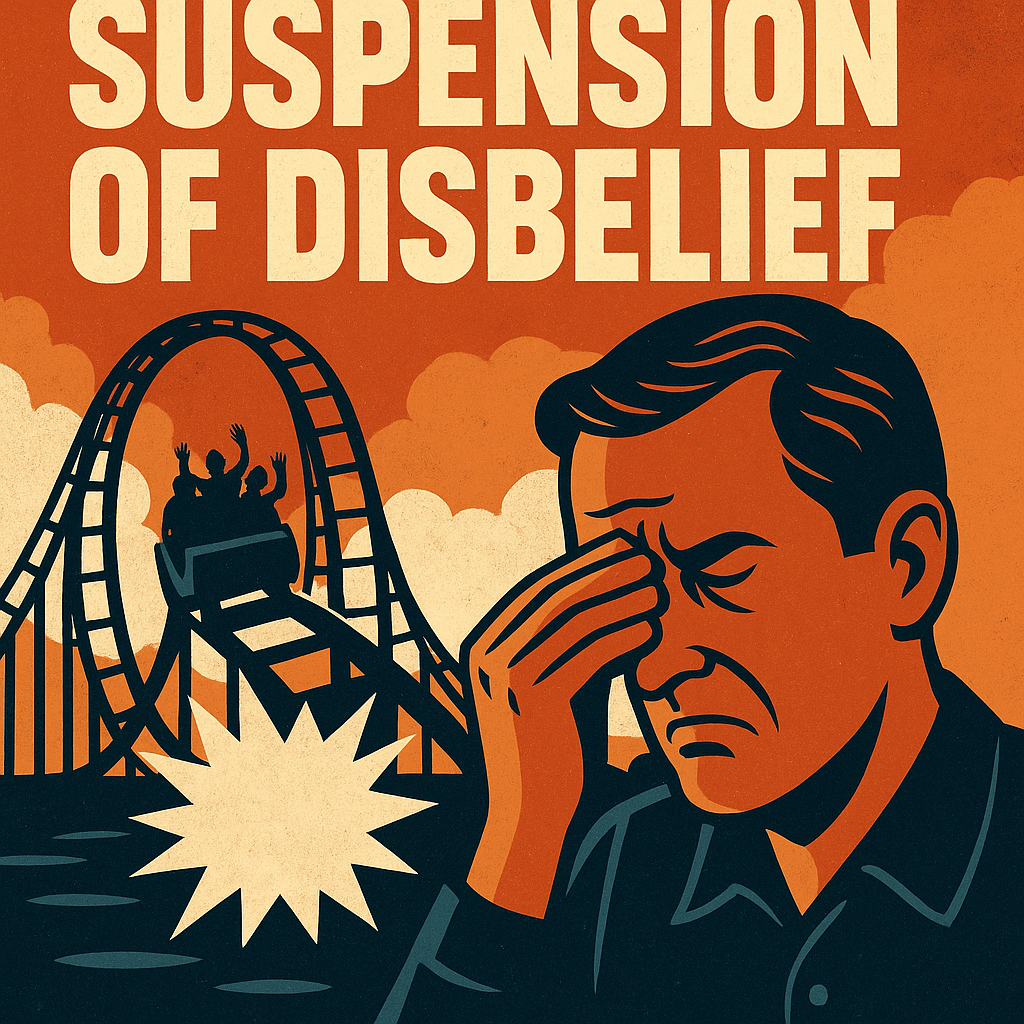
In short, in fiction, though we know the events to be fabricated, we are willing to “buy the ticket, take the ride,” as the philosopher H. Stockton Thompson once mused.
What we want to discuss here, then, is the point at which ticket holders for the rollercoaster risk being thrown right out of the car.
With that in mind, let’s look at two principles useful to bear in mind to maintain suspension of disbelief, proceed to some examples where it’s done well–as well as a rogue’s gallery of situations where it weren’t.
*But he was probably high as shit, so who knows…
**And, frankly, even non-fiction probably involves a bit more suspension of disbelief than we might like.
Worldbuilding (and World Altering)
A key principle to bear in mind:
Suspension of disbelief is maintained by following the established rules of the story world.
In short, it’s your responsibility to make sure that the world you’ve created for your characters is self-consistent.
If that’s a magical-realist world like Birdman or a supernatural world like Twin Peaks then so be it. If it’s an abstracted, absurdist world like Eraserhead, that’s also fine. If it’s a world where people randomly break into song, etc. However, introducing the Black Lodge into the world of Notting Hill would likely throw viewers for a loop.*
*But this is actually a great idea. Written down.
Figure out the boundaries of your world. Make sure that your plot devices stick to them.
This is the fundamental problem with Donnie Darko: when the physics tries to explain itself, the film simply shits the bed. The exposition is boring, the physics itself becomes inconsistent, the story itself seems incoherent, and you’re essentially glad when Donnie dies to stem the flow of brain-matter leaking out of your ears. Let this be an object lesson: if your story insists on breaking your own rules, Sparkle Motion won’t save you.
There are two ways around this problem:
- (Do the obvious thing and) keep your plot points within the bounds of the story world.
You’ll notice that this is true for most great science fiction films, including Alien and Blade Runner. Neither of these films establishes too much. They create fully formed, full functioning worlds where the plot points fit naturally inside.
Unless we’re looking at early drafts of the scripts, however, we don’t really know whether this was done with the whole world in mind, or whether the story world was reverse-engineered to fit how story and character fit together.
Therefore, if you have a really intractable problem:
- Change the bounds of the story world to match your plot points.
While I don’t know for sure that this is how Alex Garland’s writing process went, it would seem that a case such as Ex Machina is a likely example of this.
Note how the film revolves around an updated Turing Test. The simple fact of the matter, for those not familiar with the bounds of the actual Turing Test, is that one precept of the original Turing Test is that the evaluator in the test is not aware that she is interacting with a machine rather than a human being.
Clearly, this doesn’t make for interesting cinema if “people directly interacting with intelligent robots” is part of the premise. Imagine the film where Caleb interacts with Ava, but she’s a chatbot. (Just like real life!) Not the greatest visuals.
Bearing that in mind, Alex Garland created a different test whereby the character could be aware that he is interacting with a machine. Notably, Garland did such a good job with creating this updated test that the Ex Machina version is now referred to in AI circles as the Garland Test.
Research: Fact is Stranger Than Fiction
Something that we can learn from Stephenson, among others, is a good method to make the ludicrous believable.
Stephenson, in particular, is known for the density of information in his work. He understands topics–often relating to math, technology, and physics–on a demonstrably deep level. This, needless to say, accounts for his popularity among the tech crowd.*
However there exists a consequence of this thoroughness that is specifically applicable to our situation. Again, according to Stephenson: “…delving into those details eventually is going to turn up some weird, unexpected… thing that gives me material to work with, but also subliminally readers who see that are going to be drawn in more because they’re going to find that ‘oh, I didn’t see that coming.’”
In short, what Stephenson explains here is that aiming for extravagant detail is actually helpful in worldbuilding insofar as the detail-hunting will often turn up details that are surprising yet demonstrably true. Including the true-yet-surprising gives–perhaps counterintuitively–more room for information that is surprising in general.
If there’s a concern that a conceit of the script or a plot point or what have you will seem sufficiently out of place, you can always count on having an arsenal of weird-but-true items backing it up. Perhaps these prove that the world is “just weird enough” to allow the extra fictional nudge that you place in there.
For example, in Termination Shock, Stephenson introduces the idea of giant guns that send sulfur into the atmosphere to cool global warming (temporarily). This is actually a fact-based possibility that has been widely discussed among geoengineers. The fictional part is how the rest of the world would react when a rogue billionaire–pointedly not K-Bladder Boy–takes matters into his own hands.
A smaller example would be again Ex Machina, where Nathan describes Ava’s wetware brain that is able to learn as well as reconfigure its own structure. This follows current developments in neuroscience and AI hardware theory, which proposes that normal digital computers (von Neumann machines) are not fundamentally correct analogues for the human brain given that by learning our brain in fact changes its own structure.
That is, it’s a big ask for us to accept Ava as a sentient intelligence you could be capable of having a romance with.** However, when combined with niche facts like this, we let our guard down: if someone were to do what Nathan did, this seems like a more plausible way to do it.
Not that you’d have to know that fact to get the point. After all, it sounds good. However, for whatever mysterious reason, increasing the depth and validity of the niche facts seems to align the world better. Even if you’re creating a whole new world from scratch, with its races, rules, customs, and powers, like Middle Earth, it helps to understand what the niche facts are (and certainly Tolkien did understand).
Perhaps this has to do with the confidence in the writing; it seems fairly obvious when writers try to bullshit these things, but maybe that’s just me.
In short, not everything is expected to be true to life, but when you mix the “true but WTF” with the purely fictional, you’re blazing a simpler trail for the reader/viewer.
*Stephenson is a master satirist and, mercifully, unafraid of skewering even this most devoted fan base when warranted.
**Although if you yourself are in a weird Her-like relationship with Claude or whomever, no judgment.
Emotion/Tone/Pace to Fill Gaps
This concept is pretty simple.
You can get away with some pretty hilarious stuff if you have a good human story underneath.
For example, a film like The Substance is ridiculous on the surface. Elisabeth has no clear motivation to take the Substance itself (the drug isn’t what I’m complaining about). Sue has no motivation whatsoever. If you think too hard about any of this stuff, you’ll stop believing wholesale.
However, the reason I give this film a hard pass is that it presents the world in such an over-the-top way, keeps us interested with fantastic acting, and never lets dodgy logic get in the way of fast-paced fun. We could say the same for The Fifth Element, where there are certain rather tenuous plot developments, more than one deus ex machina moment, and some fairly cringe motivations. However, the pace and the fun let us enjoy the ride.
In other films, such as Primer, there is a reasonable explanation of the equipment, but we deal with the emotional complexity of using a time machine. Even in Back to the Future, we are so invested in the human story of Marty getting his parents together, we don’t really care to stare hard at ridiculous things like the Flux Capacitor.
See below for a discussion of the masterful Eternal Sunshine of the Spotless Mind.
Examples of Good Suspension of Disbelief
- Raiders of the Lost Ark
Understandably, this film involves a fairly ludicrous premise: the Nazis want an ancient Biblical artifact because they believe that it will confer “ultimate power” upon them.
However, it is known that the Nazis believed some pretty kooky supernatural stuff: so the idea itself isn’t totally out of bounds. The entire film ramps up: we get from the outset that Indy is involved in some pretty crazy swashbuckling sorts of adventures. We understand that the American Army Intelligence cats think this Ark of the Covenant thing is relevant enough to pursue.
The world is set up for us to imagine that the Ark is something. The rest of the film ramps up the silliness in many ways, with little jabs at realism added in–witness the fact that Indy isn’t getting out of all his scrapes cleanly, and that his enemies have a tendency to meet somewhat prosaic ends: think the end of the scimitar fight, the propellor and the hulking German, etc.
This actually preps us for what some might call a deus ex machina: the fact that opening the Ark is a poor move on the part of the Germans. However, note the numerous close scrapes Indy has been through at this point–yet has managed to survive, often through no real skill of his own.
We’ve been primed to believe that the man has a metaphorical horseshoe up his ass, that the Ark is worth traversing the globe for, and–furthermore–that Indy also knows better than to crack the thing open. All this adds up to a satisfying, if over the top, conclusion.
- Eternal Sunshine of the Spotless Mind
This is a masterful blend of magical realism and science fiction. Obviously the technology is speculative, but Kaufman shies away from writing too much about how it works (remember Donnie Darko). Rather, the film is squarely focused on the emotional fallout when people use the technology.
Perhaps the most intriguing thing that the script does is actually entering the memories as they’re being erased. Again, it’s not trying to explain the computer code behind why it works–it is letting the audience experience the practical effects of having one’s memory erased.
The more that we focus on the emotional, human element of the situation, the more that we are drawn along with the momentum of the story: this is happening–what next?
Poor Examples of Suspension of Disbelief – Indiana Jones Edition
- Kingdom of the Crystal Skull
As much as the team behind the film tried to retroactively justify that “it took place in the 1950s and was meant to be an alien invasion film appropriate to that era,” I was lost with the refrigerator scene.
Remember, it’s easy to lose suspension of disbelief and hard–if not impossible–to get it back.
- Dial of Destiny
While we’re at it, it takes a minute once one gets used to the slightly vomit-inducing look of the deepfake faces at the beginning of the film. What I couldn’t abide at all was a 40-year-old Indy with an 80-year-old voice.
And the rest of the film was dumb, too. I’m confident that you have enough tools to pick out all the aching suspension of disbelief gaps in the rest.
- Ghostbusters (2016)
This movie got a lot of unnecessary flak that we don’t need to go into here. I like the cast and most of the actors. The idea of the ladies was A-OK for me. It was also enough of a retread of the original two films that much of the plot more or less hung together.
Where the film really lost it for me was the idea of “killing ghosts” without any sense of what that even means–I mean given that it’s something that’s already dead and disembodied. This is unlike the idea of, say, killing a zombie in a George Romero film: even if the thing is “dead” in some sense, destroying the physical body kills the threat.
Understandably, this is meant to be a different world from the original film–hence the cameos from the original surviving three in different roles–but insofar as there’s any connection to the previous films’ world, at least a token demonstration of such differences would be helpful.
None of that here.
Conclusion
Suspension of disbelief is an important tool in your arsenal, given that literally (not figuratively) every film needs to consider it to one degree or another.
When you’re trying to make sure your suspension of disbelief works, the best things you can do are to be confident in your story world and make sure that this matches your plot points (and vice-versa).
Do your research or be thoroughly aware of the details of your world–down to the surprising ones–because this comes through.
And finally, never neglect the power of a human story or–when push comes to shove–a fast pace and splashy colors to get the job done.