

John Yorke’s Five-Act Structure for Screenwriters (Case Study: The Big Lebowski)

Especially if you’re just starting out as a screenwriter, you’re probably thinking in terms of the three-act structure. Roughly speaking, this is setup, confrontation, resolution.
Since at least the time of Aristotle, this has been the most preferred method of visualizing most dramatic arcs.
And yet, there are films–a number of great films, in fact–that never really fit this crusty-ass old “wham, bam, thank-you-sir” formula. (And a bunch of plays written by some bald guy called Bill.) It’s not that they lack structure, but we see that they’re more drawn out. Episodic, perhaps.
We see that interesting things keep happening, and–interestingly–there’s not necessarily that one key reversal at the midpoint.
One of the best examples of the five-act structure in film is the Coen Brothers’ masterful The Big Lebowski (1998).
But first, a quick recap.
John Yorke’s Five-Act Structure
Everyone loves saving the fucking cat. We get it. Enough already.
…and then there are the good screenwriting books. John Yorke’s Into the Woods is one of those. It provides a deeper structural and thematic framework than most anything else on the market. Into the Woods addresses not only plot points, but tracks the emotional resonance of these external plot points throughout the story.
Beg, borrow, or steal a copy. (Or use my affiliate link!).
(Of course Into the Woods proposes a structure that’s quite a bit more sophisticated (read: hurts producers’ brains more) than STC. Bearing this in mind, it is probably more useful for later-career films, where you can sell a script based on track record, star appeal, or general clout.
Try writing a sophisticated script as a nobody and you’ll just end up being condescended to by people who don’t fucking get it.)
As such, Yorke’s system doesn’t throw out such niceties as plot; rather, it deepens our experience of the plot because it shows us how the character changes in response to plot points. The fact that Yorke’s model tracks the protagonist’s subjective journey means it’s particularly useful for films that involve profound change–not ones where a theme is bolted on last-minute because “Blake Snyder said to.”
In this case study, let’s examine just how The Big Lebowski doesn’t quite fit a normal three-act structure. This is an interesting film from the subjective perspective as well because The Dude doesn’t really change; however, the other people changing around him (particularly Walter) provide a reflection of the subjective change that we’ve been rabbiting on about here.
But first, let’s discuss how you might tell that a film is in five acts.
Five Ways to Identify a Five-Act Film
Let’s look over the obvious signs that a film is in five acts rather than three.
First, generally speaking, you can consider each of the five acts its own mini-story. This is the part that would actually have the midpoint, arc, and resolution. They might be looser than you’d expect for a full film, but it shifts the story into the next act.
Second, there tends not to be a conveniently dramatic reversal halfway through the film. Again, you’d see this within each of the acts, but even the Third Act (of the five) might not seem as dramatic as you might expect from more standard Hollywood fare.
Third, on the same point, the midpoint usually resolves a dramatic question rather than kicking the same story into high gear. Rather, that means that one of the major plot arcs of the early part of the film is basically over. This can be thought of more as a new story than upping the stakes on the original story.
Fourth, the final act seems more like extended denouement. You could almost imagine this as an epilogue of sorts. Most of the big action is already over and you’re explaining the aftermath, or examining theme and characters’ takeaways from the story.
(In a normal Three-Act structure, the climax is very close to the end, and everything after that is just some wacky intergalactic awards ceremony.)
Basically, if you don’t know what the story is actually about if you chopped off the final 15 minutes or so, you’re likely working with a five-act film.
Fifth, there tend to be fairly significant tonal shifts across the different acts of the play. Follow the action line: some will be murder plots, others will be mistaken identity, etc. Shakespeare, in particular, is notorious for story and tone shifts act-by-act.
Now let’s look how all this maps according to…
John Yorke’s Five-Act structure
Act I: no knowledge; grounding; awakening.
Act II: doubt; overcoming reluctance; acceptance
Act III: experimenting with (new) knowledge / midpoint / experimenting with understanding
Act IV: doubt; new reluctance; regression/backsliding
Act V: reawakening; acceptance; mastery
Now let’s map each of these onto The Big Lebowski.
Five-Act Breakdown of The Big Lebowski
ACT I: It Really Tied the Room Together
- The Dude’s favorite is pissed upon by two thugs. Evidently someone who shares the Dude’s legal name, Jeffrey Lebowski, owes their boss money. That rug really tied the room together.
- The Dude, seeking recompense, visits the other Jeffrey Lebowski–the Big Lebowski, that is. Did you realize that the film isn’t named after the Dude?
- The Big Lebowski refuses to entertain the Dude’s pleas for help. The Dude helps himself to a rug from the Big Lebowski’s home before he leaves.
- Walter threatens
- Later, when the Big Lebowski’s wife Bunny is held for ransom, the Big Lebowski hires the Dude to act as bagman for the ransom payment.
Subjective Journey: no knowledge; grounding; awakening
“No knowledge” in this case means that the Dude is living at equilibrium. How can there be a problem when one simply abides?
This is of course disrupted when the rug is micturated upon.
The attempt at “grounding” is just getting things back to stasis as quickly as possible: the Big Lebowski has money and rugs and can sort this out quickly. This of course fails, at least in the way the Dude initially proposes, but he convinces Brandt to give him the rug anyway.
The problem at this point is that life refuses stasis: Walter’s disruptive behavior threatens his and the Dude’s position in the bowling league. The Dude tries to convince Walter simply to “take it easy,” but we’re pretty sure that Walter, smug as ever, will never do so.
The awakening is the call to do something outside abidance: to be the bagman for the ransom handoff. The Dude is no fool: $20,000 is enough to sway him.
Summary:
In this act, we learn quite a lot about who the Dude is, his eccentric lifestyle, and we bring up the classic noir tropes of a reckless young woman and a cranky, wheelchair-bound millionaire. There’s a reason The Big Sleep and The Big Lebowski have similar names.
The interesting bit is that we have a man who simply wants to get back to his bowling… but he lives hand-to-mouth and is swayed by an opportunity for easy money when he sees it. Of course we already know he’s a schemer because of how he convinces Brandt to give him a new rug.
Even if this is a gig the Dude doesn’t understand for people he doesn’t trust, what self-respecting slacker wouldn’t want a job that pays so well for such little work?
Act Resolution + Complication:
The rug is of course the centerpiece of the act. The thugs piss all over the rug, then the Dude goes on a quest to get a new rug. However, by the end of the act, we’re left with the complication that the Dude is pulled into the kidnapping/ransom plot.
ACT II: The Dude as Bagman, Dirty Undies (the Whites), This is What Happens When You Fuck a Stranger in the Ass
- Walter, convinced that Bunny has kidnapped herself in a ploy for the ransom money, ruins the money handoff by throwing out what he calls “the ringer”: a briefcase of his own dirty underwear.
- Later, the Dude and Walter go bowling. The Dude’s car, with the actual ransom briefcase in the trunk, is stolen from the parking lot.
- The Big Lebowski shows the Dude an envelope, allegedly from the kidnappers, that allegedly contains Bunny’s toe.
- Maude, the Big Lebowski’s daughter, asks the Dude to reclaim the money–illegally withdrawn from the family charitable foundation–from the kidnappers.
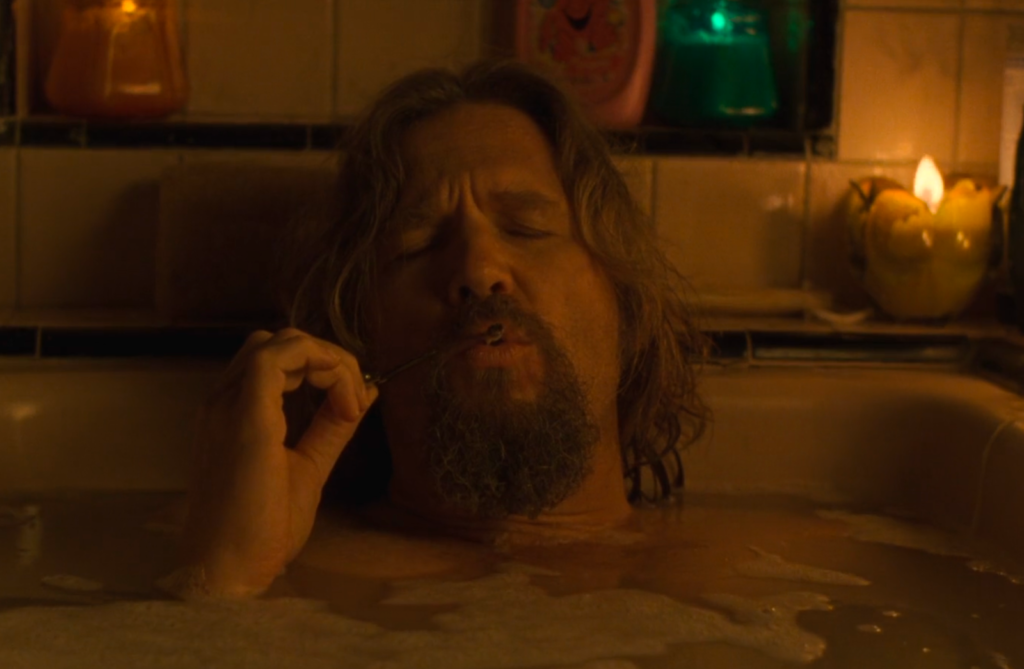
- The Nihilists confront the Dude in the bath and threaten to cut off his “johnson” if he doesn’t give them the money.
- The car is recovered by the police. Using a piece of paper left inside, Walter and the Dude track down its thief: Larry Sellers, an epically unintelligent high schooler. They are convinced that Larry took not only the car, but the briefcase.
- Larry stonewalls them. Confronting the kid leads nowhere–except embarrassment for the Dude and Walter as Walter takes a crowbar to a neighbor’s Corvette: “This is what happens when you fuck a stranger in the ass!”
Summary:
Like any good noir, this act involves new suspects and clues. It involves several interrogations. No one is sure who’s got the money. Perhaps no one. Walter rides roughshod over the Dude here; Walter does not abide. His incompetence of course fucks shit up even more.
By the end of the act, the Dude is exasperated; this is likely just about as pissed off as such a man is capable of getting. Nevertheless, his peaceful day-to-day has just been torn limb-from-limb by a cascade of complications.
Subjective Journey: doubt; resolution; complication
Doubt abounds: No one knows where the money is: not the Dude and Walter (because it’s been stolen), not Maude, who thinks that her father embezzled it, the Nihilists, who were not long fooled by the dirty undies, nor the Big Lebowski, who’s now aware that the Dude and Walter muffed the handoff.
Resolution rears its head: Then it seems that we figure out where the money has gone. The car is found, and clues lead to Larry Sellers. The moron child does a good job of unnerving two middle-aged men.
The complication is a dead end: no money and a lot of embarrassment. They’re still convinced the idiot kid has it. But if that’s the case, the Dude and Walter sure aren’t the people who will see to its return.
ACT III: Jackie Treehorn Still Wants His Money
- Jackie Treehorn’s rug-peeing thugs return and kidnap the Dude. This time they’re sure they have the right guy: they’re after “the loser Lebowski.”
- Treehorn, for his part, believes the Dude has the money. The Dude explains Walter’s theory that Bunny faked her own kidnapping. He tells Treehorn to go shake down Larry Sellers if he wants the money.
- Treehorn, unimpressed by this explanation, drugs the Dude.
- The Dude, tripping balls, has a hallucinatory sequence that ties bowling, Maude, the johnson-cutting Nihilists, the rug, and Saddam Hussein all together.
- The Dude is picked up by the Malibu police jogging down the highway as he comes down off Treehorn’s drug.
- The sheriff of Malibu forcibly evicts the Dude from Malibu.
Summary:
This is the middle of the film. It contains some of the weirdest, yet most classic sequences in the entire film. Does the Pope shit in the woods?
In essence, the Due enters the belly of the beast: Treehorn’s home. This is the guy to whom the money is owed. This is the guy who’s going to be dangerous if he doesn’t get the money. The Dude has to face him solo.
Essentially, Treehorn casts the Dude aside. Treehorn realizes that this loser isn’t going to help him get the money. (NB: it is unclear whether Treehorn ever tries to collect from Larry Sellers.)
The Dude, for his part, begins the synthesize the goings-on as he hallucinates to Kenny Rogers.
Subjective Journey: experimenting with knowledge; MIDPOINT; experimenting post-knowledge
Experimenting with knowledge: the net is closing in. The Dude feels confronted from all directions, yet completely misunderstood by everyone. This is newer, weirder, and more dangerous world than the Dude had banked on when taking the job as bagman.
The Dude is done and wants out. He speaks his mind to Jackie Treehorn, pleading his innocence. Treehorn likely gets that the Dude doesn’t have the money, but Treehorn won’t let the Dude off that easily, hence spiking the white russian.
MIDPOINT: The dream sequence, obs.
Experimenting post-knowledge: The Dude realizes that Treehorn might have played with him and cast him aside, but he still has Maude, the Big Lebowski, and the Nihilists to contend with. The journey isn’t over, and that’s a headache–as bad as the one he just got from the sheriff’s coffee mug–and he’s going to have to fix this shit himself.
Resolution:
The Dude returns to the reality of the situation. He is disoriented and beaten up but aware that he’s going to have to sort this out one way or another.
ACT IV: Maude Increases Her Chances of Conception
- The Dude returns to find his bungalow ransacked. We realize now that Treehorn drugged the Dude specifically so that his goons could turn over the bungalow in search of the money.
- Maude emerges from the bedroom, asking what happened to the place. She seduces the Dude.
- During pillow talk, she drops a bomb: there never was any ransom money. All the money was the Foundation’s money that the Big Lebowski had embezzled; he had no money of his own. He conveniently used the kidnapping to cover up his own wrongdoing.
- The Dude confronts da Fino, the PI who’s been following him; he is working for Bunny’s family back in Minnesota. Da Fino assumes that the Dude is a fellow private eye and congratulates the Dude for how he’s playing all the sides off one another. The dude tells him to fuck off.
- Walter and the Dude confront the Big Lebowski. In the meantime, Bunny has returned from her unannounced trip to Palm Springs. So it turns out the Nihilists conveniently used this fact to pretend they had kidnapped Bunny.
- Seeing that every other story they’ve been told is fake, Walter pulls the Big Lebowski from his wheelchair assuming that the Big Lebowski is faking his disability as well; he is not, as it turns out.
Summary:
Here is where all the threads of the mystery come together. It is the climax of the main mystery plot.
We finally learn what really happened:
- The kidnapping was fake: the Nihilists knew about Bunny’s trip and took an opportunity to shake the Big Lebowski down.
- The Big Lebowski, giving zero fucks about Bunny’s wellbeing, used this as a cover to explain the money he had already embezzled from the Foundation for his own purposes.
Then the Dude and Walter confront the Big Lebowski and call him on this.
Subjective Journey: Doubt / Growing Reluctance / Regression
Doubt: the Dude learns that there was never any money. He realizes that the whole bagman scheme was a scam, and that very likely he himself was “the sap to pin [the disappearing money] on.”
Growing reluctance: da Fino speaks to the Dude and the Dude finally realizes how he’s the linchpin of all the goings-on. He wants this over, and fast.
Regression: the Dude and Walter confront the Big Lebowski. They arrive moments after Bunny.
The Dude accuses the Big Lebowski of setting him up as a fall guy: a “loser, someone the square community won’t give a shit about.” The Big Lebowski tries to kick them out at this point, but Walter, convinced that the Big Lebowski is faking his injury, has other plans.
Walter pulls the Big Lebowski from his wheelchair and tries to put the whimpering old man on his feet. Letting go, the Big Lebowski collapses, defeated and sobbing on the floor. Apparently the injury is real.
He is wrong–more importantly, the lesson here is not that “everything is a scam” but rather that Walter is epically, chronically clueless.
Then Bunny arrives, safe and sound.
Resolution:
Despite being humiliated in his own study, the Big Lebowski retains the image of wealth and power to the wider community. Walter and the Dude are back to, well, the nothing they started with.
ACT V: Case Closed on the Nihilists, Donny, and Friendship
- The Nihilists confront Walter, Donny, and the Dude outside the bowling alley. They have lit the Dude’s car on fire.
- The Nihilists apparently haven’t got the memo; they’re convinced that our boys still have the ransom money.
- The Dude tries to placate them by giving them the change from his pockets. A physical altercation begins. It ends up with Walter biting part of someone’s ear off.
- When the fray clears, Donny is laid out on the ground, having a heart attack.
- Later, Walter and the Dude collect Donny’s ashes from the funeral parlor.
- Walter and the Dude take the ashes to a cliff overlooking the ocean. Walter gives an inappropriate, rambling eulogy about Vietnam. The Dude calls Walter on his bullshit: “You make everything a fucking travesty!”
- The Dude shoves Walter: the first time he has legitimately shown aggression. Walter is totally surprised. He apologizes and hugs the Dude. They go bowling.
- At the bowling alley, the Dude and the Stranger have a brief chat. “Well, you know, the Dude abides.”
Summary:
The real conflict is over. The Nihilists feel cheated, but their attack is ill-thought-out and somewhat pathetic. These clowns are the last group of people to understand that there never was any money, and they aren’t even in the loop enough to understand that everyone is over this already. They have to settle for literal (not figurative) pocket change.
What’s unexpected here, however, is Donnie’s death. However, Donnie’s death gives the Dude and Walter the chance to repair the relationship that has been thoroughly strained throughout the film. The Dude is able to step outside his abidance for long enough to shove Walter; this makes Walter realize, at least for a moment, that he has in fact been something of an asshole.
Walter hugs the Dude: his moment of self-reflection spurs him to take the first step to fixing their friendship. The two go bowling; in other words, they remain friends.
Resolution:
Issues may seem overwhelming, but they have a way of resolving themselves. One must abide.
The Big Lebowski in a Three-Act Structure
Just for the sake of argument, if we were to put The Big Lebowski into a three-act structure, it would look something like this.
Act I: The Dude’s ordinary world. The rug is peed on. The Dude is offered the chance to be the bagman.
Act IIa: The dropoff, chasing the missing briefcase around, summoned to Jackie Treehorn’s.
Midpoint: The Dude is drugged and the dream sequence.
Act IIb: The Dude returns home and learns from Maude about her father’s money. Bunny returns. The confrontation with the Big Lebowski (low point).
Act III: The Nihilists confront the Dude and Walter; Donne dies. The funeral on the cliffs. Walter and the Dude go bowling.
One of the major things this analysis compresses is the fact that the most realistic “climax” for the entire film, the confrontation with the Big Lebowski, is relegated to the low point of the script just by virtue of structure. In essence, a three-act structure forces major turning points to fit in a weird way.
Note also that you would probably expect a more major reversal at the Midpoint. We would find that either the Dude finds what he’s been after and that changes the trajectory of the whole case, or that “new shit comes to light” at Treehorn’s rather than afterward with Maude.
Furthermore, the three-act structure more or less erases Walter–along with many other thematic elements–from the major plot arc. After Walter pulling the gun in the middle of Act I, Walter is often present–and often the instigator–during the more extreme situations in the film.
Walter isn’t present for every bit of the film’s subjective arc, but he is the most obvious example of the theme: shit happens, but one must abide. That is, things often have a way of resolving themselves: Bunny will return home; the Big Lebowski will keep up his charade; the Nihilists will gain nothing for their scheme (and lose a toe in the process); Jackie Treehorn could do something evil, but he gets bored and casts the Dude loose; Donny might die, but there’s a little Lebowski on the way; Brandt still has to pay a hundred to watch.
Note how the Dude himself doesn’t change, but he inspires change in Walter. Walter of course desperately needs to “take it easy,” as the Dude repeatedly reminds him. Only through the stresses of the wider film do we see Walter get the opportunity to change. By the end, he finally does. Therefore, we see that the theme is about acceptance of the vagaries of the world, and the importance of what may be the one necessary constant to cope with an ever-changing world: healthy companionship.*
This is why the Yorke model works particularly well for the Big Lebowski. It doesn’t throw out the three-act structure. Rather, it allows for nuance and subjective arc where in a three-act structure we’d only be looking at plot. Arguably, the perennial interest in The Big Lebowski is because of the depth of its characterizations–essentially its subjectivity–so it necessarily gives the film short shrift to prioritize only its objective plot as we see in a three-act analysis.
*See also A Serious Man on this point.
Some Takeaways
Here are some practical thoughts that you can take away from this discussion.
First, think about how each act as a whole reflects the theme:
Act I: The Dude’s normal world is disrupted, but trying to correct the problem simply makes things worse. In essence, the Dude is wrong that other people might also be expected to abide.
Act II: Walter’s madcap plan to steal the money backfires, but in a totally unexpected way (the car is stolen). Part of friendship is that sometimes friends make it impossible to abide.
Act III: The Dude plays it cool, abiding and telling the truth, as far as he knows it. Treehorn could shake the Dude down further, but realizes it’s a lost cause and cuts the Dude loose–but not before slipping the mickey. Abidance FTW.
Act IV: The Dude learns that he’s been played for a fool. He’s deep enough into the situation that he knows it needs to resolve before he can abide once more. Sometimes abidance requires decisive action.
Act V: We learn that nihilism will get one nowhere. In times of crisis, all we have to rely on is those closest to us. Abidance requires a healthy friend group.
Second, consider that the–potentially unnecessary–Act V is a mirror for the rest of the film. Since it doesn’t matter particularly to plot mechanics, it likely describes something more subjective: the importance of friendship to the Dude’s worldview.
Third, given that the climax happens in the fourth act, it seems like it happens 15-20 minutes “too early.” If you’re seeing this in your own film, you might actually have created a five-act film.
Fourth, note how the structure of the film reflects the character: obviously, the Dude abides. It tells a story in a much more subtle way than we expect from normal Hollywood fare. Things don’t really climax for the Dude in any major way.
This of course doesn’t imply that The Big Lebowski is aimless. Maybe it’s just not obvious. It might have plenty of absurd moments, but it raises profound questions and is too intelligent to provide pat answers.
The structure of the film–subtle, meandering, lazy, but complete–matchees the theme, tone, and the character of the Dude.
After all, the film ties all of its loose ends up. The mechanics of a noir plot are often an afterthought given that beyond a certain level of complexity, no one (but me, apparently) really gives a shit. You’ll see numerous classic noirs fail this test (e.g., who killed Carol Lundgren in The Big Sleep?), but the Coens are too smart for this. They tied up all the loose ends.
We aren’t given any sort of clear resolution; rather it’s just a return to status. The only thing that has changed is that perhaps Walter is a little bit less of an asshole.
Life, like the Dude, abides.
Five-Act Structure Exercises
To learn more about the five-act structure and see whether you can apply it to your own film, check out the PDF exercises listed here: